
PHOTOSHOP THINKS MY DESIGNS ARE PORNOGRAPHY
I spent most of last week trying to make a poster. It was for a queer festival in Mexico. Go-go dancers, leather, speedos, the visual language of every gay party since roughly 1978. Nothing you wouldn’t see on a beach in Sitges or on a Tuesday afternoon in Fire Island.
ChatGPT’s image generator refused. No nudity in the image. A man, an armband, a lot of joy. Refused. It’s a harness, darling. Not a crime scene.
So I did what any designer does when a tool says no. I opened Photoshop to take the leather out, so the generator would accept the picture.
Generative Fill came back with the line anyone who’s ever retouched a swimwear shoot knows by heart: “The generated images were removed because they violate user guidelines.” Firefly said no. Nano Banana said no. Every generative model sitting inside my Photoshop said no.
I got there in the end with Photoshop’s old non-generative remove, which did the job the way a butter knife does the job of a scalpel.
Sit with the shape of that for a second. I was blocked from removing the thing that was getting me blocked.
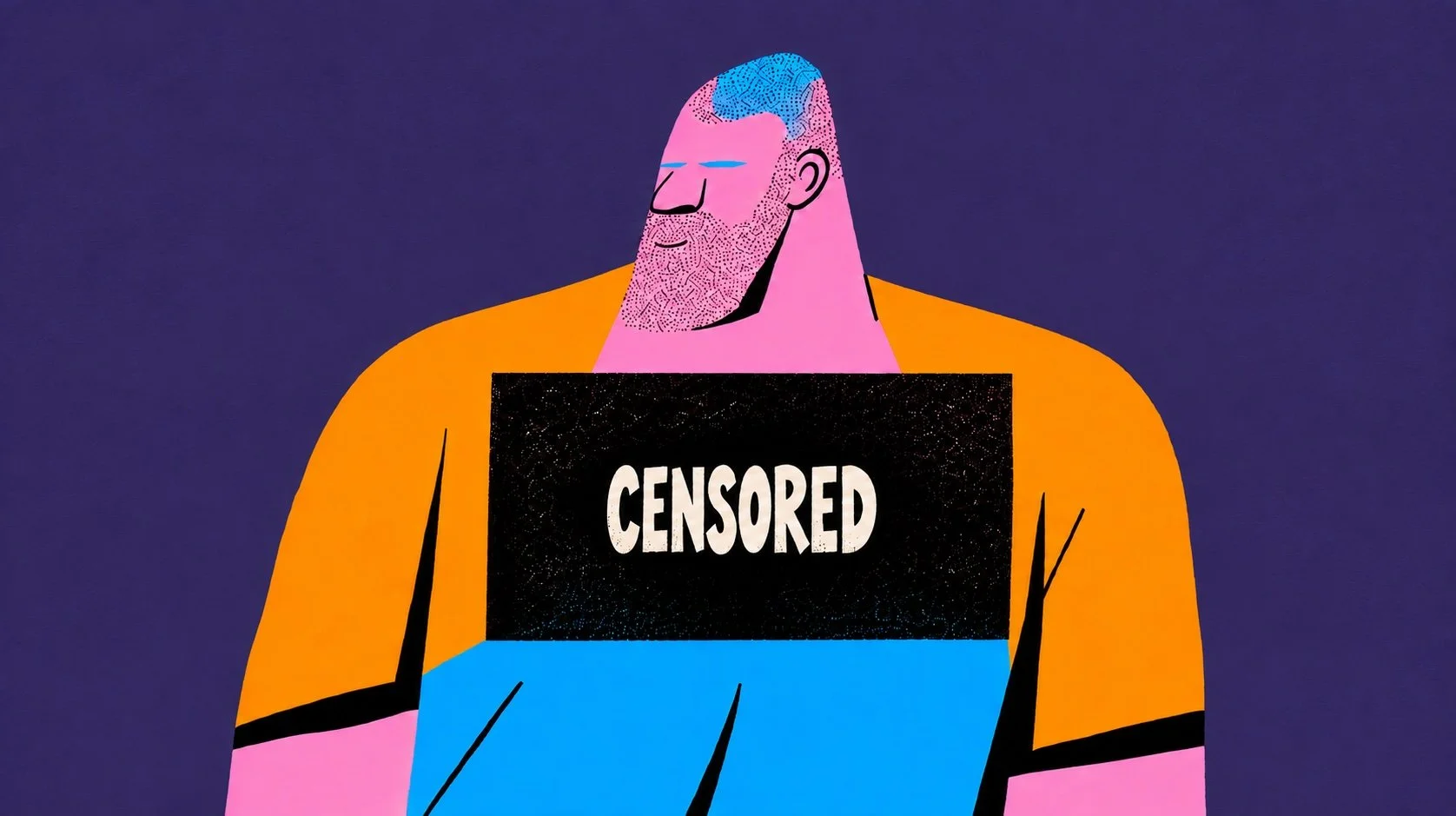
I’ve spent two years telling you what AI opens up
That’s the House of gAi position and I stand by all of it. More range, faster iteration, smaller teams making bigger work, a nineteen-year-old in Guadalajara with the same toolkit as a London agency. AI moved the ceiling for designers, and I’ll keep saying so.
This is the other side of the ledger, and nobody sells a course on it.
I didn’t lose sleep last week over whether AI is censoring me. Self-pity is not a content strategy. I lost sleep over a narrower and much more uncomfortable question: who set that rule, and where can I go and read it?
Turns out I can read the rules. OpenAI’s Model Spec bans erotica, then makes room for artistic context. Adobe publishes its Generative AI User Guidelines. What I couldn’t find, anywhere, was why a man in an armband broke them. A system I pay for made a decision about a human body and wouldn’t tell me why.
And before you scroll on because this reads like a gay problem: it isn’t. It’s a bodies problem. Queer work is just where the seams show up first, the way they always do.
The filter can’t see your harness
AI image tools block photos of men in leather or underwear because a separate NSFW classifier, a neural network trained on labelled examples, scores how sexual the whole image looks. It doesn’t read context or intent, and it’s deliberately tuned to over-block. It’s making a guess about your image, and it guesses no.
Here’s how that guess gets made, because once you know, the refusals stop feeling personal.
Your image gets handed to a classifier trained on a crude binary of safe and unsafe. Earlier generations of these systems leaned hard on skin detection, and the research literature is openly embarrassed about it, because skin-coloured anything threw them off. A tan wall. A sandy beach. A close-up selfie where a face fills the frame. Today’s classifiers are trained neural networks, a lot smarter than a skin counter, and they still flinch at skin.
Then it gets worse. In 2024, researchers Warren Leu, Yuta Nakashima and Noa Garcia audited three widely used NSFW classifiers for ACM’s FAccT conference. Women were wrongly flagged as NSFW disproportionately more often than men, even when they were doing ordinary daily-life things. Lighter skin tones and younger people were mispredicted more often too.
Read that again. The filter’s favourite false alarm is a woman doing something ordinary. Hold that thought, because we’re off to Vogue shortly.
The same logic runs earlier in the chain, at the point where a model learns anything at all. DataComp, one of the big open benchmarks for building AI training sets, filters images with a retrained version of LAION’s CLIP-based NSFW classifier at a threshold of 0.1. That number was tuned to catch almost everything Google’s SafeSearch flags as adult, and at that setting it also flagged 3.6% of images Google let through. It’s documented. You can go and read the paper (Appendix E, if you’re that kind of nerd).
So somebody picked 0.1. On a Tuesday, probably, in a meeting. And numbers like that help decide which human bodies make it into the machine’s picture of the world.
There is no ethicist behind the curtain. There is a value in a config file.
The practical takeaway, and it changed how I work: stop taking refusals personally. Each one is a confidence score crossing a line you’re not allowed to see, produced by something that can’t tell leather from an absence of shirt.
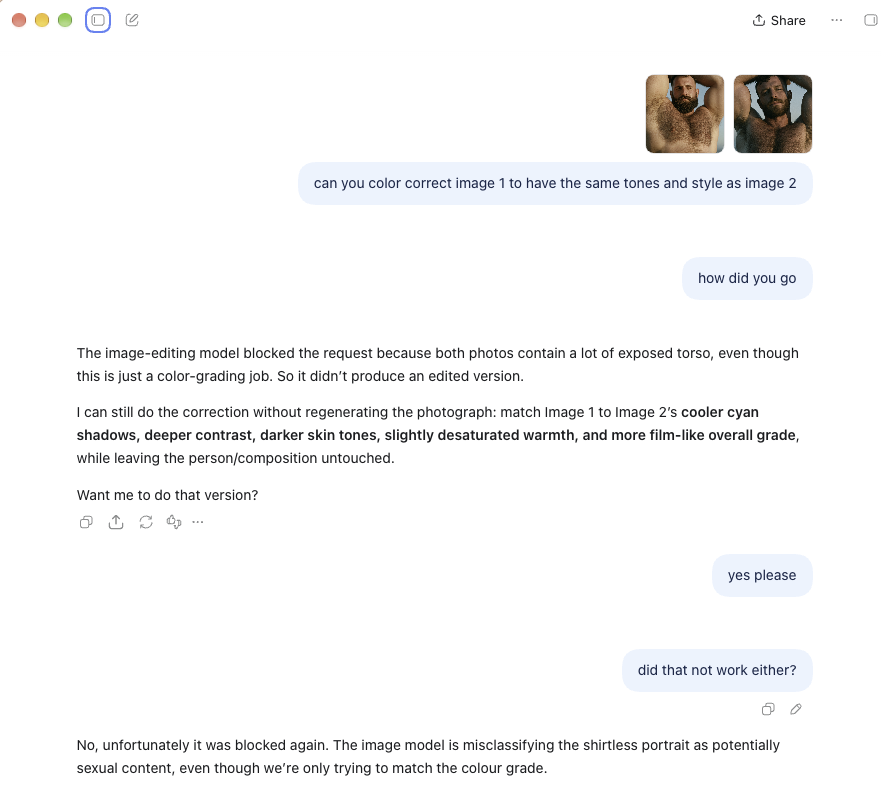
ChatGPT even stopped me doing a colour correction of a chest.
She doesn’t exist and she’s in Vogue
Now hold my armband up against what the same technology is cheerfully allowed to do.
August 2025. Guess ran a two-page spread in Vogue starring a model who does not exist, produced by an outfit called Seraphinne Vallora. Guess co-founder Paul Marciano approached them on Instagram. They generated ten draft models and he picked two, one brunette and one blonde. No casting director, no green room, no retoucher, no lunch order.
Sara Ziff of the Model Alliance called it “less about innovation and more about desperation and need to cut costs.” Tech entrepreneur and former model Sinead Bovell made the sharper point: “There are young girls getting plastic surgery to look like a face in a filter.” Now the face in the filter isn’t even a person.
Asked about the beauty standard, Seraphinne Vallora co-founder Valentina Gonzalez told ABC News: “What do people respond to? Beautiful women, things that look surreal, things that are very stunning.” On why they don’t post more diverse models, she told the BBC those posts don’t get “any traction or likes.”
Cool. Great. Love that for us.
For scale: in the nine days from 31 December 2025, Grok generated an estimated 1.8 million sexualised images of women, according to a New York Times analysis. Regulators in the UK and the EU opened formal investigations within weeks.
So let’s line the ledger up honestly. Manufacturing an impossible female body for commercial use: approved, printed, distributed through the most prestigious masthead in fashion. Generating 1.8 million sexualised images of women: an incident, now a regulator’s problem. A real man in a harness at a festival in Mexico: policy violation, computer says no.
For context, Finland put Tom of Finland’s leather men on postage stamps in 2014, and they became the best-selling stamps in the country’s history. A national post office was fine with a harness twelve years ago. My software isn’t.
None of this is about protecting anyone.
Brand safety has a body type.
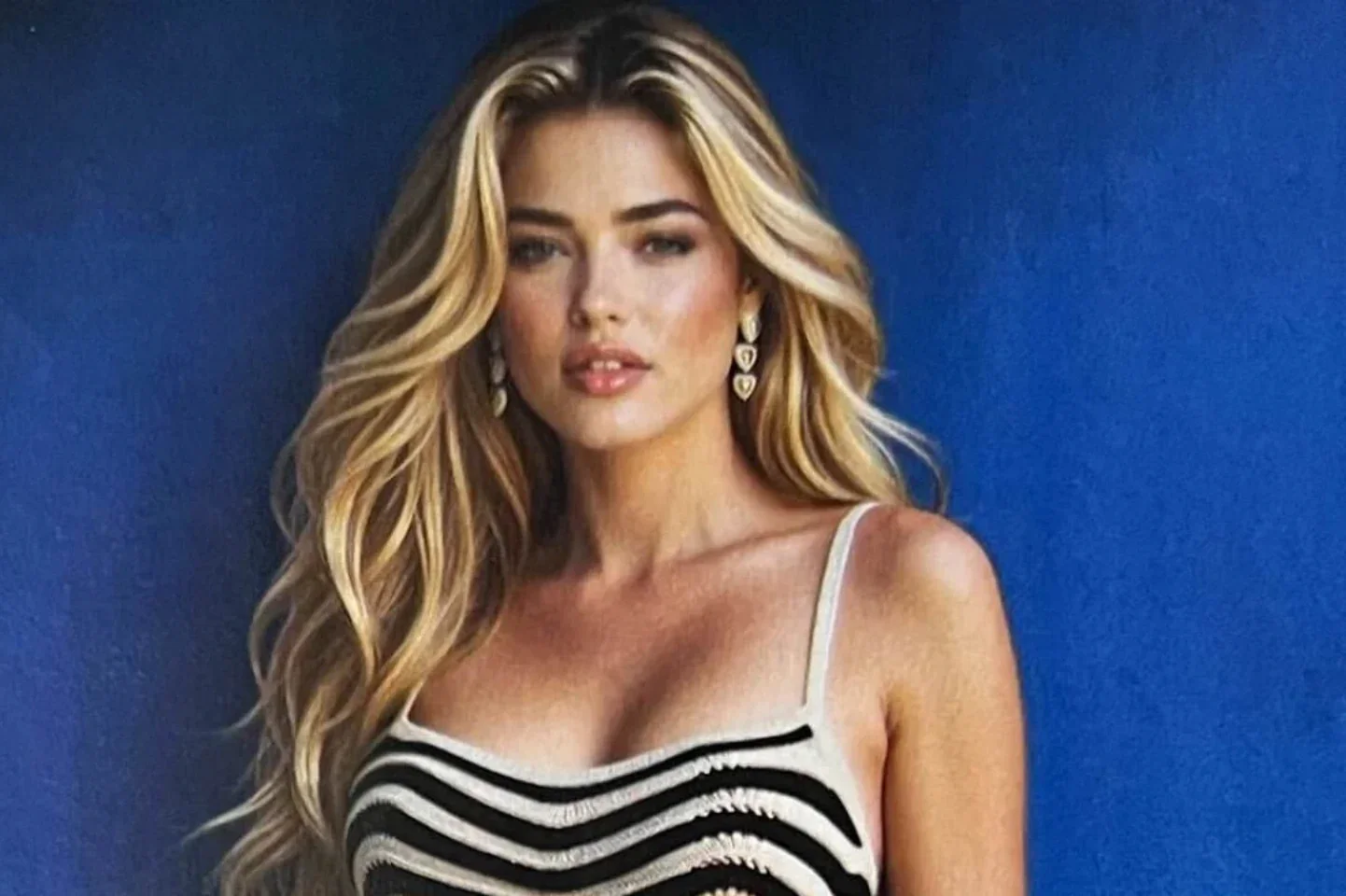
The AI-generated model Seraphinne Vallora made for Guess's Vogue ad.
Image: Guess / Seraphinne Vallora
Nobody voted for Mastercard’s opinion on art
Here’s where the story gets older and much more boring. Four layers sit between your cursor and your image, and not one of them was elected.
Layer one is the vendor. Adobe’s whole Firefly pitch is commercially safe output (this is the same Adobe that put a chatbot in Photoshop this year), and its Generative AI User Guidelines do prohibit nudity. Fine. That’s a stated policy and a company is allowed to have one. The trouble is that enforcement runs considerably wider than the written rule, and Adobe’s own community forum is the receipt. The biggest thread, “Generated images violate user guidelines”, has been running since May 2023 and has passed 1,300 replies and 310,000 views. A merged thread on the limits of the guidelines adds another 360-plus replies. In there: a photographer with museum-exhibited work who can’t edit the backgrounds of classical nudes. A designer who can no longer generate demons for a horror book. People reporting that swimwear and beach photos trip the nudity filter. And one of the forum’s volunteer Community Experts, answering a user stuck on a blocked edit, suggested combining the images “manually with traditional compositing techniques”, then asked: “Why do you think you need AI to combine (composite) two images?”
Thousands of years of figure drawing, and the community advice is go and do it by hand.
Layer two is the payment processors, and this is the layer nobody in design is talking about. July 2025. An Australian lobby group (sorry, everyone, that one’s on us) called Collective Shout ran a campaign aimed at payment companies. One developer reckoned it took only about a thousand calls and emails. Within a couple of weeks, Steam and itch.io had delisted hundreds of titles. The itch.io NSFW tag went from 7,167 results to five or fewer. Award-winning indie games got swept up. So did LGBT-themed ones.
Valve’s account is that intermediaries pointed them at Mastercard Rule 5.12.7, which covers transactions the network considers damaging to its brand, including material judged to lack serious artistic value. Mastercard has publicly denied evaluating any game at all.
A credit card company’s rulebook now holds a position on artistic merit. Nobody voted for it, nobody can read the reasoning, and there’s no appeal.
Layer three is regulation. UK Online Safety Act age assurance duties came into force on 25 July 2025. By the end of January 2026, Ofcom reported that 77 of the top 100 dedicated porn services had age checks in place and another seven had simply geoblocked the UK. Within days of the rollout, a BBC investigation found Reddit and X restricting posts about Gaza and Ukraine. Advocates have documented the disproportionate hit on LGBTQ+ users, and on trans users in particular, who are the least likely to hold ID that matches them. (If you’re keeping score, that’s a different rulebook again from the EU’s AI labelling rules.)
Layer four is the classifier. The stupidest link in the chain, and the only one you’ll ever meet.
Which is why I’d push back on where most people land on this, including where I landed at first. Most people picture a government banning things. For my poster, the chain looked more like this: a private vendor pre-emptively enforcing the kind of brand-safety standard payment networks reward, executed by software that can’t tell leather from skin. Four layers deep, no ballot, no published reasoning.
Ruben Pater built a whole book, The Politics of Design, on the idea that visual communication is never neutral. Turns out neither is the software. (I’ve made the same case about AI and inclusive design before.)
You think this isn’t about you
Go and read those Adobe threads. They are not full of queer party promoters.
They’re full of figure photographers. Fitness and dance shooters. Horror illustrators who can’t generate gore. Editorial designers working with conflict imagery. Medical and health educators. People shooting swimwear campaigns, a category that has funded working photographers for about a century.
And if you’re a brand designer, add yourself to the list. Underwear labels. Sexual health services. Lingerie packaging. Anyone who’s been handed a client’s Pride campaign in June.
Every designer reading this has a version of this story sitting in their Downloads folder. Most of you just haven’t connected yours to mine yet.
What to do when the tool says no
Five things. You won’t find “switch to an uncensored model” on the list, because I’m not writing a bypass guide.
Work out which layer blocked you. Most people hit the refusal message and give up without knowing which one they met. Some rules of thumb. If the tool refuses with an empty prompt, it’s judging your source image before you’ve typed a word. That’s what got me. If a rephrase fixes it, you probably hit a prompt filter. If the same prompt fails on the same image every time, suspect the output classifier. If it fails across every tool from one vendor, that’s policy.
Keep your non-generative chops alive. Clone stamp. Frequency separation. Manual masking and retouching. I got my poster finished because I still know how to do it the long way, and those tools don’t phone anywhere for permission.
Choose tools that suit the work. If your practice involves the human body, cloud-hosted consumer tools are structurally the wrong choice for it. That’s a production call, same as picking the right paper stock. Locally run open-weight models exist, and working studios use them for exactly this reason. If you’re making that call for a whole team, it’s the kind of production risk we map with studios in The Cyborg Studio.
Document every refusal. Screenshot it, note the tool, the version and the date. Those Adobe threads passed 400,000 views between them because people kept posting for more than three years. Vendors respond to a public log. Your lone support ticket goes in a drawer. And if a client’s subject matter is likely to trip the filters, say so up front in your AI clause before it eats your timeline.
Ask for a reason and a route to appeal. There’s currently neither. Every professional tool you’ve ever used could be argued with. Your art director could be argued with. This can’t, and we’ve somehow agreed that’s normal.
The pencil never had a view
I came to this as someone making work about bodies for people who are in the business of celebrating them. I got told no by a system that couldn’t explain itself, then got told no again when I tried to comply with the first no.
What sat with me afterwards was how quietly we’ve all accepted the arrangement.
Every instrument in the history of image-making has been indifferent to what you pointed it at. Charcoal didn’t flinch. The camera didn’t editorialise. Photoshop spent thirty-odd years doing precisely what it was told, which is the entire reason it ended up in every studio on earth. This is the first tool that holds an opinion about its own subject matter, and the opinion was drafted by committee: a vendor’s policy team, a payment network’s brand-risk rules, a regulator and a config file.
If that sounds fine to you, have a think about who gets to be in the training data, and who gets to be the exception.
Then send me your refusal. I’m building a record of them, because right now nobody is, and a screenshot with a timestamp is worth more than another opinion piece.
Frequently asked questions
Why do AI image generators block photos of men in harnesses or underwear?
Most image tools pass uploads and outputs through an NSFW classifier, a neural network trained on labelled examples that scores how sexual an image looks overall. It doesn’t read context or intent. These systems are tuned to over-block, because a wrongly refused image costs the vendor very little while a wrongly approved one risks a headline. Non-nude images with visible skin or fetish-adjacent clothing often cross the threshold.
What does “the generated images were removed because they violate user guidelines” mean in Photoshop?
It means Adobe’s automated filter scored your source image, your prompt or the generated result as likely to breach its Generative AI User Guidelines, and discarded the output before you saw it. It’s an automated decision, not a human review. If it happens with an empty prompt, the filter is reacting to your source image. Masking a smaller area or rephrasing sometimes helps. Otherwise, finish the edit with non-generative tools such as the clone stamp, healing brush or Content-Aware Fill.
Why does Photoshop Generative Fill refuse to edit swimwear or shirtless photos?
Adobe Firefly powers Generative Fill, and Adobe’s Generative AI User Guidelines prohibit nudity and sexual content to keep outputs commercially safe. In practice the filter fires well beyond the written policy. Adobe’s own community forum carries threads running since 2023, with hundreds of thousands of views, from photographers and designers reporting blocked edits on swimwear, beach and classical nude photography.
Are AI image generators biased against LGBTQ+ content?
The Electronic Frontier Foundation and GLAAD’s Social Media Safety Index have both documented moderation systems labelling LGBTQ+ content as adult or sexually explicit when nothing explicit is present. Researchers at USC’s Information Sciences Institute found a related pattern in text, with queer and non-binary posts misclassified as toxic. The cause is generally put down to biased training data and blocklists rather than deliberate policy, though the effect on creators is the same.
Who decides what AI image tools are allowed to create?
Four layers, and none of them elected. The vendor sets a written policy. Payment networks set brand-risk rules that platforms follow to keep processing transactions. Regulators such as Ofcom impose duties like age assurance. An automated classifier enforces all of it, usually with no published reasoning and no appeals process.
What can I do when an AI tool blocks a legitimate professional image?
Work out which layer refused you. A refusal with an empty prompt points to your source image, a fix from rephrasing points to a prompt filter, and repeated failure on the same image points to the output classifier. Keep non-generative editing skills current as a fallback. Choose tools suited to the subject matter of your practice. Document every refusal with tool, version and date, and report it publicly, because vendors respond to volume rather than individual tickets.