
INVISIBLE INK: THE EU MADE AI DISCLOSURE LAW. THEN CLAUDE STARTED WATERMARKING ITS WORDS
Two things happened in ten days, and together they close a chapter. On 2 August 2026, the EU's new AI labelling rules went live. Some AI-generated work now legally needs a visible "made with AI" label when it's shown to audiences in Europe.
Then on 11 August, Anthropic announced that Claude embeds an invisible watermark in the text it writes. Not metadata that dies when you export. A mark woven into the words themselves, one that travels when the text gets copied and pasted somewhere else.
So the era of quietly using AI and never mentioning it? Over. And before the panic sets in: the actual rules are far more chill than your LinkedIn feed suggests. Most of what you make with AI needs no label at all. Here's the designer's version, no law degree required.
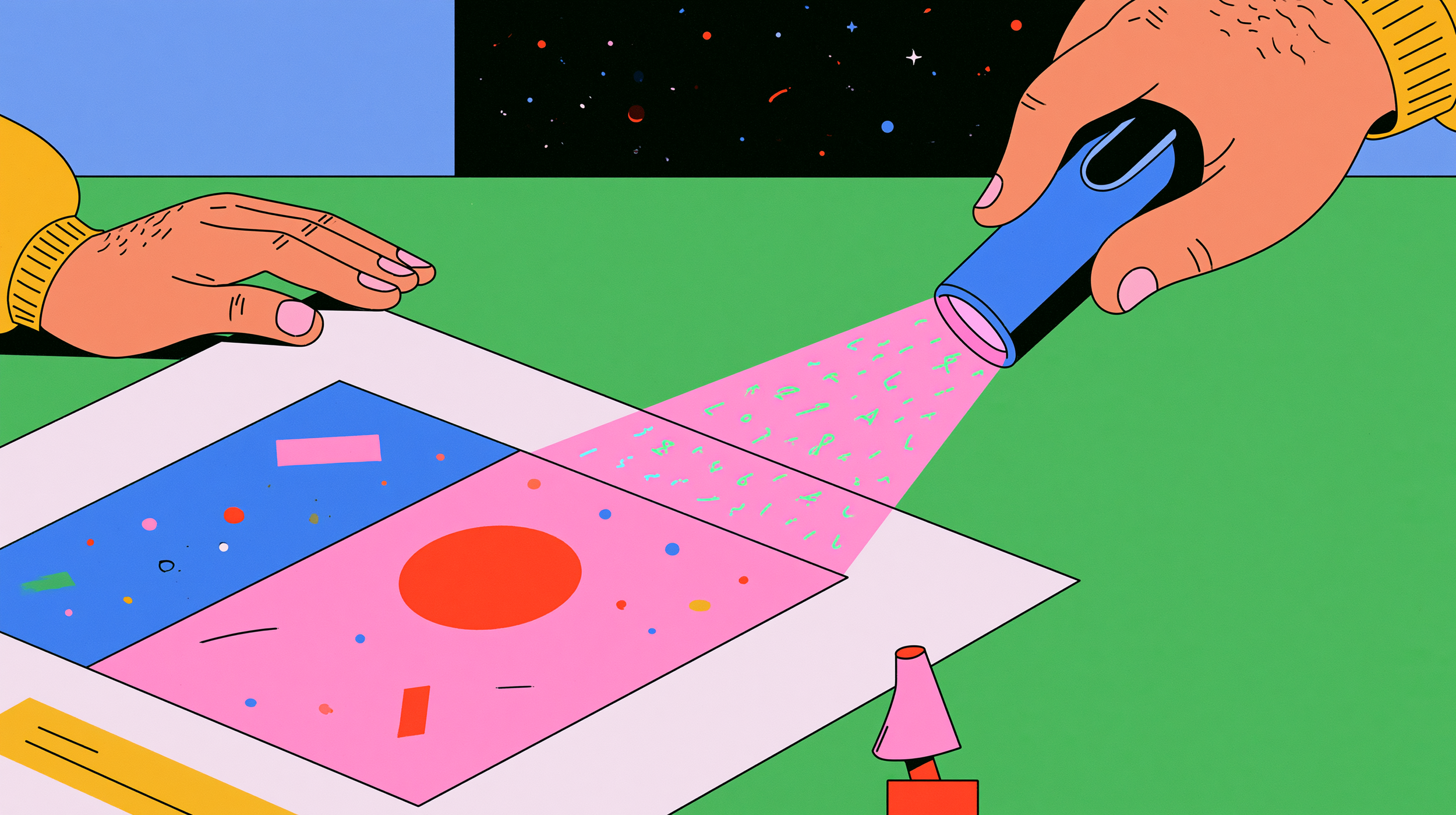
No, you don't have to label every AI image
Read that again, because half the internet currently has it backwards.
The new EU rules don't care about your AI-assisted logo. Or your abstract poster. Or your gloriously unhinged illustration of a dragon perched on the Berlin TV tower, because nobody thinks that's photojournalism.
What the law targets is work that could fool people into thinking it's real. The official term is "deepfake", and it covers more than face swaps. Three questions decide it:
Does it show real people, places or things (or ones that could plausibly be real)?
Could the subject plausibly exist?
Would someone believe it's an authentic photo, video or recording?
All three yes? It needs a visible label. Any no? You're out of scope. That's the whole test, and it takes two minutes at sign-off.
One catch worth knowing: your intentions don't matter. That photoreal AI model you generated for a campaign, art-directed with love and zero deception in your heart? Still needs the label, because viewers would read it as photography.
And breathe: nothing made before 2 August 2026 needs labelling retroactively. Your back catalogue is safe.
Where it actually touches your work
Here's the test applied to the stuff designers make:
Photoreal AI models. The big one. Remember the Guess ad in Vogue's August 2025 issue, with an AI-generated model and a tiny corner credit reading "Produced by Seraphinne Vallora on AI"? The TikTok backlash pulled two million views before any law existed. Under the new rules, the label has to be clear and visible at first glance. The corner whisper won't cut it.
Virtual staging and interiors. The EU's own example: a real photo of an empty apartment, furnished with AI. That's "AI-modified" and needs saying so. Product-in-context shots live near this line too.
Realistic renders. Architectural visualisation made the design press this month. As lawyer Szymon Sieniewicz told Dezeen: "If it's realistic scenery with people walking around and it is AI generated, it will need to be labelled as AI generated." The viz community mostly welcomed it, which tells you something.
Voice clones, de-aging, digital doubles. Obviously. Consent first, label always.
What doesn't need a label: cropping, colour correction, cleanup, background tidying, format conversion. Your Tuesday retouching is not a legal event. AI-written marketing copy is mostly fine too; the text rules only bite on public-interest journalism-style content, not your product headlines.
Art gets a gentler deal: work that's evidently creative or satirical still discloses, but in a way that doesn't wreck the piece. A caption, a credit line. Think of it like the credits at the end of a film. Advertising, though, rarely gets to claim that exception. Yes, that stings.
Ignore all of it and the fines can reach €15 million or 3% of a company's global turnover. Those are ceilings for serious cases, not parking tickets for freelancers, but they're why your clients are about to start asking questions.
The tools started signing their own work
Now the watermark news, because it changes the mood.
Claude's text now carries an invisible mark that survives copy-paste and may persist through some editing. Its images carry Content Credentials. Google's been watermarking text since 2024. Firefly attaches credentials to everything it generates. One by one, the tools are signing their homework whether you mention them or not.
Three things to know before anyone spirals. A detected mark means Claude touched the text; it may have just proofread your human-written paragraph, so it's not proof AI wrote anything. Heavy editing or paraphrasing can remove it, and it's less reliable on short passages and code. And detection is coming to everyone: on 14 August, Anthropic announced an API that will let third parties check text for the mark.
But don't miss the direction of travel: provenance is becoming part of the file format of creative work. Which makes "I'll just not mention the AI part" a strategy with a shelf life.
And it isn't just Brussels. California's AI Transparency Act kicked in the very same day, 2 August, requiring big generative AI tools to offer free public detection tools and embed provenance metadata, with fines of $5,000 per violation per day. Midjourney got publicly singled out on day one for shipping neither. Wherever you work, this is the new weather.
Here's the trap, though. That embedded metadata does not count as your visible label. The law wants disclosure humans can see, not data software can read. And the metadata often doesn't even survive the journey anyway: platform testing has repeatedly found Instagram reads Content Credentials and shows its "AI info" label but metadata rarely survives a download-and-reshare, while YouTube's transcoding destroys it entirely. The visible label is a design deliverable now. Treat it like one, and make it look considered. If anyone can make a mandatory label beautiful, it's you.
The 58% problem
The uncomfortable stat: Envato surveyed 1,780 creative professionals and found 58% had used AI in client work without ever disclosing it. Meanwhile 91% of designers now use AI at least weekly, per Fast Company. AI use is nearly universal. Silence about it is the norm.
That silence was always a trust debt. The EU just started charging interest.
But here's what the doom-posters skip: the evidence says disclosure hurts way less than designers fear. A study of 900 consumers found AI labels caused no drop in brand recognition, ad memory or ad liking, and separate survey data found 44% of people liked ads more once they knew AI was involved. (One German-led study found the opposite, to be fair. The honest read: the label doesn't sink good work. Weak work sinks work, and a label on weak work is just a signed confession.)
The industry moved before the regulators did anyway. Designers are already doing this in the open, and D&AD now requires AI disclosure on every award entry. Design fairs are getting called out for showing undisclosed AI work. The culture set the direction; the law is just the paperwork catching up.
"Disclosure isn't a confession, it's a credit line. Designers have signed their work for a century. The label is just the 2026 version of the signature."
— Anthony Wood, founder, House of gAi
Your two-minute studio upgrade
Six moves, Monday-morning ready:
Run the three questions at sign-off. Real-looking? Plausible? Passes as authentic? Add it to your pre-flight checklist next to "spell-check the client's name."
Design the label. Build "AI-generated" and "AI-modified" label components into your templates. The EU published free optional icons in June if you want a starting point.
Keep a one-line note per asset. Tool, date, what was AI versus human, who reviewed it. Thirty seconds now, a very good day later if a client asks.
Put it in the contract. Agree in writing who labels the work and who keeps the label on it downstream. Settle it at briefing, not in a crisis.
Don't strip provenance. Let Content Credentials and watermarks ride along. Costs nothing, reads as professional.
Tell clients before they ask. The designer who walks in with a disclosure policy looks senior. The one who goes quiet when asked does not.
Sign your work
Designers have never wanted anonymity. We fight for credits, chase bylines, put our names in the colophon. The entire history of this craft is people insisting that someone made this.
AI disclosure is that same instinct pointed forward. The tools are signing their work now. The law expects you to sign yours. The only question left is whether your signature reads as an apology or a flex, and that has nothing to do with regulation and everything to do with the quality of what you ship.
Where design is heading in 2026,. The best AI-made work won't look AI-made. It'll look like yours. Now it can say so out loud.
Building AI into your practice and want to do it properly, disclosure and all? That's the whole reason House of gAi exists. Come learn with us.
Want to make creative work that integrates Ai into your creative process without replacing you? That’s what we teach in the AI Branding Masterclass.
FAQ
Does the EU AI Act ban AI-generated design work? No. AI-assisted design stays fully legal, and most AI work needs no label. Since 2 August 2026, visible labels are required for deepfakes: realistic AI images, video or audio that could pass as authentic to viewers in the EU.
Do I need to label an AI-generated logo or illustration? Usually no. Logos, abstract graphics and obviously fantastical images don't need labels because nobody would mistake them for real photography. Photorealistic people, places and products are where labelling kicks in.
Does the law apply to designers outside the EU? It can. If your work is used in the EU, the rules can reach you whether you're in London, Mexico City or Melbourne. EU-facing campaigns should assume they're in scope.
Is Adobe's Content Credentials or Claude's watermark enough to comply? No. Embedded metadata is the tool company's job. If your work counts as a deepfake, it needs a separate label humans can actually see at first glance, and many platforms strip metadata anyway.
What is Claude's new text watermark? As of August 2026, Anthropic embeds an invisible watermark in Claude-generated text that survives copy-paste and may persist through some editing, plus Content Credentials on images. A detection API for third parties was announced on 14 August 2026. A detected mark means Claude may have processed the content; it isn't proof AI wrote it.
What are the penalties for not labelling AI content in the EU? Fines can reach €15 million or 3% of worldwide annual turnover, whichever is higher (for small businesses, whichever is lower). These are maximums for serious cases, applied proportionately, not automatic fines.
Sources
Consolidated EU AI Act (Reg. 2024/1689): https://eur-lex.europa.eu/eli/reg/2024/1689/2026-07-27/eng
European Commission Article 50 FAQ: https://digital-strategy.ec.europa.eu/en/faqs/transparency-obligations-under-article-50-ai-act
Commission enforcement news, 2 Aug 2026: https://digital-strategy.ec.europa.eu/en/news/commission-starts-enforcing-ai-act-rules-and-new-transparency-requirements-2-august
EU AI labelling icons (incl. the apartment example): https://digital-strategy.ec.europa.eu/en/policies/eu-icons-labelling-ai-generated-content
Anthropic, "How Claude marks AI-generated content": https://support.claude.com/en/articles/16266773-how-claude-marks-ai-generated-content
TechCrunch on the Claude watermark (11 Aug 2026): https://techcrunch.com/2026/08/11/anthropic-says-it-will-watermark-text-generated-by-its-ai-models/
The Decoder on Anthropic's detection API (14 Aug 2026): https://the-decoder.com/anthropic-announces-watermark-detection-api-that-will-let-third-parties-detect-claudes-ai-texts/
TechTimes on the California AI Transparency Act and Midjourney (2 Aug 2026): https://www.techtimes.com/articles/322713/20260802/california-ai-transparency-act-operative-midjourney-has-no-watermark-fines-start-today.htm
Dezeen on AI architectural renders (10 Aug 2026, Sieniewicz quote): https://www.dezeen.com/2026/08/10/ai-architectural-renderings-eu-ai-act/
Lewis Silkin on AI labelling in the advertising supply chain: https://www.lewissilkin.com/insights/2026/07/31/the-new-ai-labelling-rules-for-deployers-in-the-advertising-supply-chain
Reed Smith on the Code of Practice and the "evidently creative" exception: https://www.reedsmith.com/our-insights/blogs/viewpoints/102nbz0/transparency-obligations-for-ai-generated-content-the-code-of-practice-adequacy/
Dezeen opinion on design fairs and undisclosed AI (28 May 2026): https://www.dezeen.com/2026/05/28/design-fairs-need-to-adopt-ai-policy-now/
Envato, State of AI in Creative Work 2026 (58% stat): https://author.envato.com/hub/beyond-adoption-the-state-of-ai-in-creative-work-2026/
Fast Company / Designer Fund (91% stat): https://www.fastcompany.com/91543989/ai-in-design-design-jobs-2026
MediaScience via eMarketer (labels didn't hurt ads; 44% figure is separate eMarketer survey data): https://www.emarketer.com/content/ai-ads-isn-t-problem-most-consumers-lack-of-disclosure
NIM, "Transparency without trust": https://www.nim.org/en/publications/detail/transparency-without-trust
Guess/Vogue AI model coverage: https://www.marketing-interactive.com/outrage-erupts-as-vogue-runs-guess-ad-with-ai-generated-model
D&AD Awards AI disclosure: https://www.dandad.org/awards/d-ad-awards/whats-new
AI Act penalties (Art. 99): https://artificialintelligenceact.eu/article/99/