
WHY EVERY DESIGNER NEEDS AN AI CLAUSE IN THEIR CONTRACTS (FREE TEMPLATE)
Clients now arrive with AI-generated "creative direction," submit designer deliverables to AI tools for feedback, and expect work in jurisdictions where AI copyright is unresolved. An AI clause in your design contract solves all three. Hey Studio in Barcelona has been running one for over a year. Zero pushback from clients. Here's why every designer needs one, what it should cover, and a free paste-ready template you can adapt.
Key takeaways
AI is now a contract question, not just a workflow question. Clients arrive with AI-generated briefs, request AI-driven revisions, and copyright rules are still catching up.
Hey Studio has an AI clause in every client contract. Their reasoning: "There are no laws about that. So we need to create our own rules."
An AI clause covers three things: the designer's use of AI, the client's use of AI on the delivered work, and the copyright status of AI-assisted output.
Zero pushback from clients. The clause sets the tone from day one and clarifies expectations both ways.
A free template is available below, drawn from working-studio practice. Adapt it and get a lawyer to review anything material.
What is an AI clause in a design contract?
An AI clause is a section added to a design service agreement that defines how artificial intelligence tools are used during the project, what restrictions apply to the client's use of AI on the designer's work, and how copyright and disclosure are handled. Two years ago, this would have felt like overkill. In 2026, it's a working-studio essential.
Here's why the shift happened, and why the designers ignoring this are quietly walking into scope creep, copyright ambiguity, and integrity-of-work problems that didn't exist three years ago.
Why designers need an AI clause in 2026
Three things have changed in the last eighteen months.
One. Clients now regularly arrive with AI-generated moodboards, logos, or brand imagery and treat it as approved creative direction. "This is what we want. Make it." No brief. No strategy. Just an image out of the model.
Two. Clients submit designer deliverables to AI tools for automated feedback and revision requests. They plug your logo into an AI and ask it to critique the kerning. They request changes based on those critiques. Your creative judgment gets flattened into a prompt engineering exchange.
Three. Copyright of AI-generated or AI-assisted content is unresolved in most jurisdictions. In the US, purely AI-generated work has no copyright protection under the Thaler ruling. In the EU, the AI Act is layering additional disclosure obligations onto commercial AI use. In practice, "who owns this?" just became a contract question.
None of these are edge cases. They're happening in freelance briefs and studio contracts every week.
How Hey Studio wrote AI into their client contracts
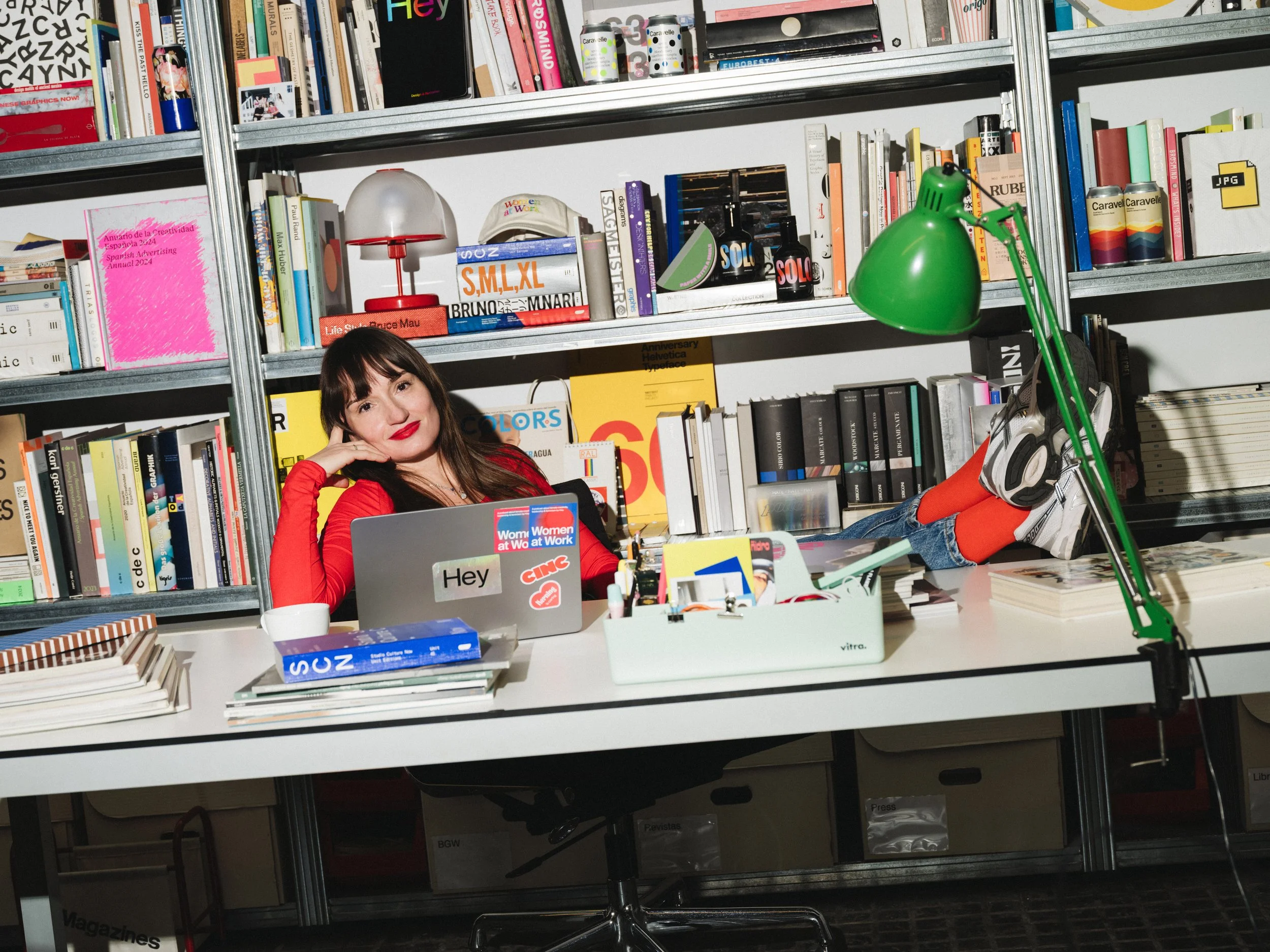
Last month, I sat down live with Veronica Fuerte, the founder of Barcelona's Hey Studio, inside the House of gAi Creative Futures Hub. Hey has been quietly building one of the most thoughtful AI workflows I've come across. And they've written an AI clause into their standard client contracts.
Her reasoning was direct:
"There are no laws about that. So we need to create our own rules."
—Veronica Fuerte, Hey Studio
What the clause protects against, in her words:
"When we receive briefs made with AI, or images making with AI, like 'we want this or something like that,' it's no, no, no. I mean, I don't accept this kind of images."
—Veronica Fuerte, Hey Studio
That's the client-provided-AI-content problem. The clause draws a hard line. AI-generated moodboards can be shared as reference or inspiration, with clear labelling. They cannot arrive as creative direction Hey is expected to execute against.
The second thing the clause does is protect the integrity of the work once Hey has designed it. Veronica again:
"AI can be a great tool for exploration and prototyping. But it shouldn't replace the strategic and creative thinking behind a project."
—Veronica Fuerte, Hey Studio
Once the work is delivered, clients agree not to submit it to AI tools for feedback, edits, or derivative versions. That's what protects the craft.
The surprising part? Zero pushback from clients. Not one. The clause just sets the tone from the first conversation.
What every AI clause should include
The template we're releasing today is a starting point for solo freelancers and small studios. It's paste-ready, drawn from working-studio practice, and covers the areas current industry commentary flags as the actual risk zones.
Eight sections make up a comprehensive AI clause.
1. Definitions. Clear language on what "AI Tool" and "AI-Generated Content" mean inside the contract. Without this, the rest of the clause floats.
2. Designer's use of AI tools. States that the designer may use AI tools during the process, that all deliverables are directed and approved by the designer, and that the categories of AI tools used will be disclosed on request. Transparency protects you legally and manages client expectations.
3. Confidentiality and client materials. The designer won't input confidential brand assets, unreleased visual materials, or proprietary client content into public AI models without written consent. Where AI is used with client materials, enterprise or private-mode services that don't train on inputs are used instead.
4. Client-provided AI content. The client agrees not to provide AI-generated content as approved creative direction. This is Veronica's core protection. AI-generated moodboards can serve as reference material with clear labelling and no expectation of execution.
5. Restrictions on client use of deliverables. The client agrees not to submit the designer's work to AI tools for feedback or critique, use AI to edit or generate derivative works, or use the deliverables as training data. This protects the integrity of the work post-delivery.
6. Copyright and ownership. Both parties acknowledge that AI-generated content may have limited copyright protection in some jurisdictions. Where AI has contributed to deliverables, the designer documents the human authorship and creative direction involved.
7. Warranties. The designer warrants human creative judgment across all deliverables but does not warrant the copyright status of purely AI-generated elements. Liability for third-party claims arising from the client's misuse of deliverables through AI is excluded.
8. Right to refuse. The designer reserves the right to decline scope changes that would require executing AI-generated content as final creative.
Get the free AI clause template
The full paste-ready template — with all eight sections, a disclaimer, and a note for larger studios — is available as a free PDF download.
It's built for solo freelancers and small studios. For studios of 5+ people or high-value client work where AI is central to the practice, the template is a starting point but not sufficient. Get in touch and we'll help you build a full AI policy addendum for your specific engagements.
Three things most designers get wrong about AI clauses
Since releasing the template, three patterns have emerged in the questions I'm getting back.
Assuming the clause is the full policy. The template gives you contractual language. But the harder question is what your own practice actually is. Which AI tools are you using? On what kinds of projects? What client materials would you never feed into a public model? Write your own policy first. The clause is the client-facing version of your policy, not a replacement for it.
Copy-pasting without adapting the language. The template uses jurisdiction-neutral English. That's deliberate. But your existing contract has its own defined terms, its own tone, and its own jurisdiction-specific hooks. Match the clause to the rest of your contract before you paste. Bring a lawyer in on anything material.
Only thinking about protecting yourself. The best AI clauses I've seen also give clients clarity. When you can explain your AI policy in one paragraph, clients trust you more, not less. Transparency around AI use is turning into a real differentiator with clients who are watching the industry go sideways.
Copyright and AI: the bit designers keep missing
One area of the clause that regularly gets overlooked is the user rights and copyright block. Veronica flagged this specifically in the talk:
"We need to be very clear about user rights. Because if we do, if we use AI for creating images, we need to credit that. There are some specific platform tools that have user rights. But for apps that we know don't have user rights, this is very important to know."
—Veronica Fuerte, Hey Studio
Different AI platforms have wildly different terms around what you own when you generate output. Some (like Adobe Firefly for commercial-safe imagery) explicitly grant broad rights. Others reserve rights, retain training claims, or leave the status ambiguous.
The clause doesn't solve this on its own. But by acknowledging the copyright status of AI-generated elements, and by requiring the designer to document human authorship, it puts a defensible position on record if a client (or a court) ever asks the question.
When you need more than a template
For solo designers and small studios, the template is enough for a starting point. It's what most working freelancers need right now.
For studios of 5+ people, high-value brand launches, or client work where AI is central to the practice, the template isn't sufficient. What you need instead is a full AI policy addendum that covers your specific engagement types, IP handoff, client onboarding, and team-level AI protocols.
If that's you, get in touch. Email ant@houseofgai.com and we'll build one together.
The bigger picture
Adding an AI clause to your contracts puts you ahead of the vast majority of working designers right now. Most haven't thought about it. The ones who have are quietly protecting their practice, their work, and their client relationships. The industry is still catching up. The designers who move first get the head start.
If you want to go deeper into how working designers are integrating AI without losing the craft, we run monthly conversations with leading studios inside the Creative Futures Hub. Recent conversations include Veronica Fuerte (whose clause inspired this template), Studio Dumbar, Andrea Mata from Runway, Alex Naghavi, and more.
The full Veronica Fuerte talk (where she walks through the clause and much more) is available in the VIP vault, along with the rest of the guest speaker back catalogue.
Frequently Asked Questions
What is an AI clause in a design contract?
An AI clause is a section added to a design service agreement that defines how artificial intelligence tools are used during the project, what restrictions apply to the client's use of AI tools with the designer's work, and how copyright and disclosure are handled. It typically covers designer AI use disclosure, client-provided AI content restrictions, restrictions on the client submitting deliverables to AI, and copyright acknowledgements.
Why do designers need an AI clause in 2026?
Clients now regularly arrive with AI-generated moodboards, request revisions based on AI-generated feedback, and expect designers to work with AI without clear rules. An AI clause protects designers from AI-adjacent scope creep, defines what clients can and cannot do with AI-assisted deliverables, and provides clarity around copyright status in jurisdictions where AI-generated content has limited copyright protection.
What should an AI clause include?
A comprehensive AI clause should cover: definitions of AI tools and AI-generated content, the designer's use of AI tools and disclosure obligations, confidentiality restrictions around inputting client materials into public AI models, prohibitions on the client providing AI-generated content as creative direction, restrictions on the client submitting deliverables to AI tools, copyright and ownership acknowledgements, warranties, and the designer's right to refuse AI-adjacent scope changes.
Do I need a lawyer to add an AI clause to my contract?
For material contracts or high-value client work, yes. Contract law and AI regulation are evolving quickly in every major jurisdiction. A template gives you paste-ready starting language, but a qualified contract lawyer should review the wording before you rely on it, especially for large projects, public brand launches, or jurisdictions with specific AI disclosure requirements like the EU AI Act.
Can I use the House of gAi AI clause template as-is?
The template is a starting point for solo freelancers and small studios, drawn from working-studio practice as of mid-2026. Adapt the wording to your practice, your scope of work, and your jurisdiction before using it. For studios of 5 or more people, or high-value client work where AI is central to the practice, contact House of gAi for a bespoke AI policy addendum.
About the author: Anthony Wood is the founder of House of gAi, an educational platform helping designers integrate AI into their creative process. He runs the AI Branding Masterclass and hosts monthly talks with leading creatives inside the Creative Futures Hub community. Read the full conversation with Veronica Fuerte and Hey Studio here.