
THE AI IN DESIGN 2026 REPORT FORGOT GRAPHIC DESIGNERS EXIST
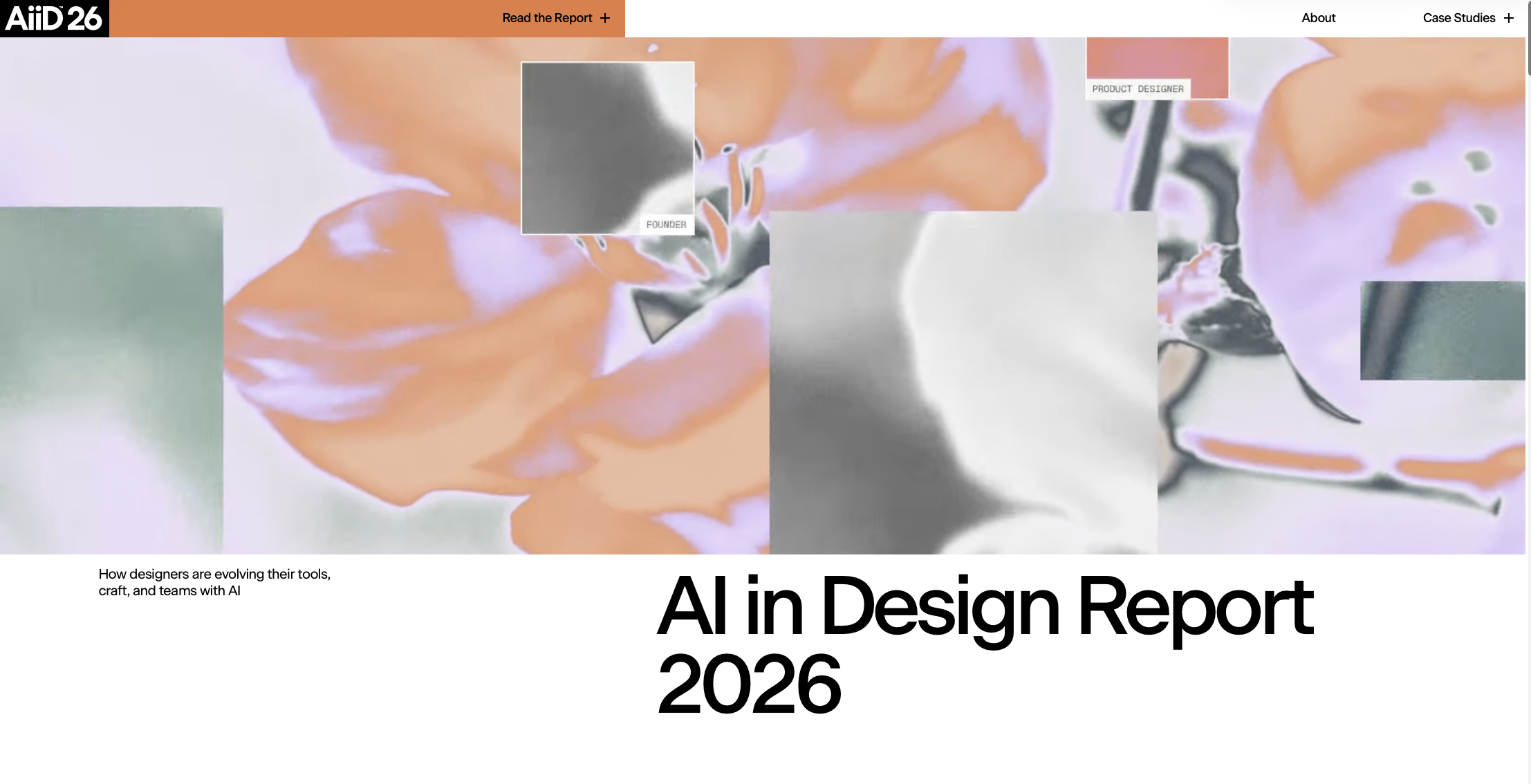
Your feed is full of it this month. "91% of designers now use AI weekly." "Half of designers shipped code to production." "Claude overtook ChatGPT." Beautiful charts, big numbers, the AI in Design 2026 report getting quoted in every newsletter, group chat and LinkedIn hot take like scripture. So I decided to dig into it a little deeper to see what it means for the graphic design and creative industry.
That landmark study, the one about to define how the whole industry talks about "design and AI" for the next twelve months, barely surveyed graphic designers at all. 86% of its respondents are product designers at tech companies. Just 12% work in an agency. If you're a brand designer, an illustrator, an art director, a studio of one, this "state of design" survey covered your industry about as well as a surfing magazine covers the desert.
That's not a knock on the report. It's a genuinely brilliant piece of work, for the people it actually asked. The problem is who's quoting it as if it describes you.
So let's do the thing nobody else is doing. Let's read the methodology, not just the headline, and figure out what the biggest design report of the year actually means for graphic designers and the studios they work in.
TL;DR
The AI in Design 2026 report by Designer Fund and Foundation Capital is excellent. But it's mostly about in-house product designers at tech companies, not graphic designers, brand studios or agencies. Its sunny numbers (everyone's shipping, everyone's thriving) come from people with company-funded tools, AI budgets and "tinkering time." That's not most creatives' reality.
The honest answer for graphic designers is more interesting than the headline: AI is splitting creative work in two. Commodity work is collapsing toward free. Taste-led, human-directed work is going premium. Your move isn't to panic about a report that wasn't measuring you — it's to climb toward the end of the market AI can't reach.
Want to think this through with people who actually get it? We run free live sessions inside the Creative Futures Hub. No hype, no fear, just clear thinking about craft. You're invited.
The report everyone's citing surveyed the wrong designers
Let's start with who actually filled out this survey, because it changes everything that comes after.
The AI in Design 2026 report (stateofaidesign.com) is built on 906 designers. Sounds comprehensive. But look at the breakdown: 86% do product design. 71% are in-house. Only 12% sit in an agency, and brand or marketing design is a minority specialty in the sample. Then read the questions: they're about shipping code, building prototypes, design systems, developer handoff, pull requests.
That's not graphic design. That's software product design wearing the word "design" like a borrowed jacket.
And here's the thing about the report's relentless optimism: it's structural. These designers have company-funded tool budgets, internal AI champions, "tinkering time," and a $50-a-month stipend to play with new toys. The report says 87% get at least moderate organisational support for AI. Of course they're having a great time. Now compare that to the freelance brand designer paying for Midjourney out of her own pocket between invoices, or the five-person studio with no "AI enablement program" and a client who just asked why the logo costs more than a Canva subscription.
Same word, "designer." Completely different weather.
A study can survey 900 designers and still miss your entire industry. Read the methodology before you swallow the headline.
None of this makes the report wrong. It makes it specific. The mistake is treating a Silicon Valley product-team survey as the state of all design, and then panicking about numbers that were never measuring your job.
So… will AI replace graphic designers?
Short answer: no, but it is replacing the easy, repetitive, commodity slice of the work, and that part isn't coming back. Every serious 2026 data point says the same thing: AI is reshaping graphic design, not deleting it.
The numbers back the calm version of this story. In a Clutch study, 88% of businesses reported using AI design tools, but only 18% said AI had reduced their need for designers. Read that twice. Adoption is near-universal; replacement is the exception. Businesses are using AI to make more stuff, faster, and they still need humans to make it good.
What's actually disappearing is the bottom rung. The four-second logo. The template social pack. The "just make it bigger" production work that never paid well and never felt like design anyway. McKinsey estimates up to 30% of tasks in creative industries could be automated this decade. Tasks, not careers. The job isn't vanishing. The grunt work is.
The fear in "will AI replace graphic designers" is real, and it deserves a real answer, not a motivational poster. So here it is: the designers who get squeezed are the ones whose entire offer was execution speed. The designers who thrive are the ones selling judgment, strategy, taste and story, the stuff a text box can't generate. We wrote a whole piece on what humans still own when the machine gets good: Is AI replacing designers? What Gemini reveals about what designers still own.
Is graphic design a dead career in 2026?
No. But "just being a designer," a pair of hands that pushes pixels on request, is dying. The career is splitting into two very different futures, and where you land is mostly a choice.
This is the part the product-design report completely misses, because it wasn't looking at your market. For graphic and brand creatives, AI didn't flatten the field. It barbelled it. Two opposite forces are pulling at once:
At the bottom, the floor is dropping out. Freelance graphic design work shrank an estimated 17% within eight months of ChatGPT's launch, according to research out of Harvard and Imperial College. Commodity gigs are racing toward free.
At the top, human-made is going premium. A 2026 Gartner survey found roughly half of consumers would rather buy from brands that avoid generative AI in their messaging. The "human-made premium" is becoming a real market position, the same way "organic" became a label people pay extra for. When Gucci ran an AI campaign in early 2026, the backlash was about craftsmanship. When Intermarché ran an all-human film made by 80 people over a year, it outran AI-made ads from far bigger brands. Audiences can feel the difference. Increasingly, they're paying for it.
The dangerous place to stand is the soft middle: fast enough to be commoditised, not distinctive enough to be premium. Graphic design as a career is very much alive. "Generic graphic design" is the thing on life support.
What the report did get right (and why it matters to you)
Credit where it's due. Buried under all the code-shipping product talk, the report lands on something true for every kind of designer.
Even among those AI-soaked product teams, the human refuses to hand over the keys. 81% said they still rely on their own final visual polish and quality decisions over AI. 79% rely on their own creative direction and aesthetic judgment. The machine drafts; the human decides. That's not a graphic-design idea or a product-design idea. That's just design.
This is where the whole conversation has been quietly migrating: away from "who can make it" and toward "who knows whether it's any good." Taste. Judgment. The ability to look at fifteen AI-generated options and kill fourteen of them for the right reasons. The industry spent 2026 rediscovering this and calling it a "moat," as if creative directors hadn't been doing exactly that for forty years.
AI can move pixels. It still can't do the thinking part. The thinking is the job now more than it's ever been. And that's genuinely good news for anyone willing to lead with their head instead of just their hands.
What graphic designers and agencies should actually do about it
Enough diagnosis. Here's the part you can act on Monday morning.
Move up the barbell, on purpose. Audit your last five jobs. Which pile are they in, commodity or crafted? If too many are in the "anyone-with-Canva-could-brief-this" pile, that's your signal. Start repositioning the offer around strategy, brand thinking and creative direction, not turnaround time. Selling speed is a race to zero. Selling judgment compounds.
Make AI part of a system, not a panic. The designers who feel grounded aren't chasing every new app. They're building intentional workflows where AI handles exploration and grunt work, and human judgment stays firmly in charge of meaning. That's exactly the shift we break down in AI for Graphic Designers in 2026: How to Integrate AI Into a Real Design Workflow. And if you want to see a real studio doing it well, here's how Studio Dumbar uses AI without diluting authorship.
Protect your authorship, legally too. Here's a detail the design report skips entirely: in 2026, work generated purely by AI, with no meaningful human input, often can't be copyrighted. For agencies delivering client work, "who actually owns this?" just became a contract question. Direction, editing and iteration are what make your authorship (and your client's ownership) defensible. We unpack it here: The AI copyright battle is just beginning: here's why designers should care.
If you lead a studio, get ahead of your own team. Your designers are almost certainly already using AI. Quietly, on personal logins. Pretending otherwise doesn't protect the work; it just removes the quality bar and the ethics check. Turning that shadow adoption into a deliberate, on-brand capability is exactly what we help studios do in our AI training for design agencies.
Wrapping it up
The biggest design report of 2026 is worth reading. Just read it for what it is: a snapshot of in-house product teams at tech companies, not a verdict on graphic design.
The real takeaways for creatives:
AI isn't replacing graphic designers. It's deleting commodity work. Adoption is near-universal; replacement isn't.
The market is splitting. Generic work goes to zero; human-led, taste-driven work goes premium.
Taste and judgment are the job now. The report's own data agrees: 8 in 10 designers still trust their own eye over AI.
Your authorship is your asset, creatively, commercially and legally. Protect it.
AI didn't kill creativity. Mediocrity was doing fine on its own. Your taste is the scarce thing now. So sharpen it, direct with it, and stop competing on the work a machine can already do.
Want to go deeper, with people who care about craft? Come think it through in the Creative Futures Hub. Or if you're ready to build a real AI-integrated process, that's the whole point of the AI Branding Masterclass.
FAQ: AI and graphic design in 2026
Q. Will AI replace graphic designers?
A. No. AI is automating the repetitive, commodity parts of graphic design (basic logos, template layouts, quick social graphics), but it isn't replacing designers. In a Clutch study, 88% of businesses used AI design tools yet only 18% said it reduced their need for designers. Strategy, taste, brand thinking and creative direction remain human-led.
Q. Is graphic design a dead career in 2026?
A. No, but it's transforming. "Generic" execution-only design is shrinking, while taste-led, strategic and human-directed work is becoming more valuable. The career is splitting into commodity work (under pressure) and crafted work (going premium). Designers who lead with judgment and story are in demand.
Q. What does the AI in Design 2026 report actually say?
A. The AI in Design 2026 report by Designer Fund and Foundation Capital found that 91% of surveyed designers now use AI weekly, around half have shipped AI-generated code, and toolstacks have more than doubled. But 86% of respondents are product designers and only 12% work in agencies, so its findings describe in-house tech product teams far more than graphic designers or studios.
Q. Does the State of AI in Design report cover graphic designers and agencies?
A. Barely. Only about 12% of respondents work in agencies, and the survey focuses on product-design workflows like prototyping, code and developer handoff. Graphic, brand and studio work is underrepresented, which is why its conclusions shouldn't be read as the full picture for creatives.
Q. Are graphic designers still in demand?
A. Yes, for the right skills. Demand is shifting away from pure execution speed and toward creative direction, brand strategy, systems thinking and AI-augmented workflows. Designers who can direct AI and bring taste and storytelling are increasingly sought after; those competing only on output speed are most exposed.
Q. What skills do graphic designers need to stay relevant with AI?
A. Creative direction and taste, strategic and brand thinking, storytelling, systems thinking, and the ability to direct and curate AI rather than be replaced by it. Knowing when not to use AI matters as much as knowing how. Protecting human authorship (including for copyright) is now a core professional skill.
Q. Can AI-generated graphic design be copyrighted?
A. In many regions, work created entirely by AI without meaningful human input isn't protected the way human-made work is. Courts increasingly look for "significant human intervention." Direction, editing, recomposing and iterating make your authorship visible and your (or your client's) ownership far safer.
About the author
Anthony Wood is the founder of House of gAi, where he helps graphic designers, studios and agencies fold generative AI into real creative work without surrendering the craft. He created the AI Branding Masterclass and hosts the Creative Futures Hub, a community for designers working this shift out together. After 20+ years in the industry, he still believes taste is the whole job. Come say hi.