
HEY STUDIO’S VERONICA FUERTE: THE DESIGNER WHO PUT AI IN HER CONTRACT
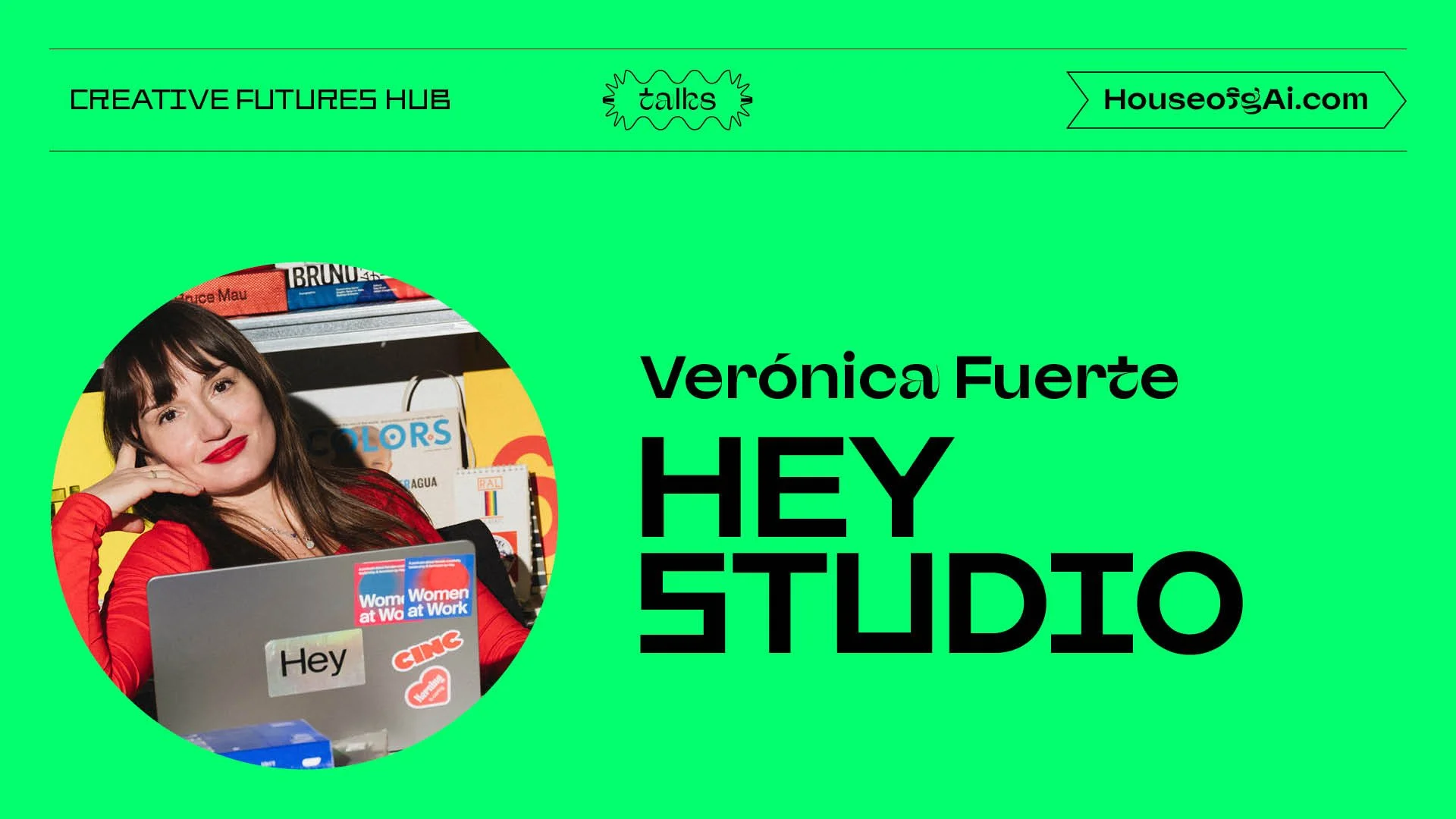
Veronica Fuerte, founder of Barcelona's Hey, has built one of the most thoughtful AI workflows in design. From prototyping bag collections in AI, to writing clauses into client contracts, to running a weekly experimentation block called Hey Lab, she joins the House of gAi community live on Wednesday, June 17, 2026 to share how she's making it work.
Key takeaways
AI enters Hey Studio's process at prototyping and execution. Strategy, concept, and creative direction stay entirely human.
The most underrated AI use case isn't prompting, it's building your own tools. Veronica builds custom mini-applications in Claude to handle repetitive motion design tasks.
Hey Studio now writes AI clauses into client contracts to protect creative direction and the integrity of the work.
Hey Lab is a weekly studio block dedicated to experimenting with new tools. A recent Hey Lab project: a lamp designed entirely with AI, now moving into production.
"Perfect kills the soul." Veronica treats AI as one process among many, not the process.
AI goes where it earns its keep
Where does AI actually fit into Hey Studio's design process? Most of the AI-and-design conversations I sit in fall into two camps. The evangelists, who can't stop posting about every new model the second it drops. And the quietly panicked, who'd quite like the whole thing to stop happening, thanks.
Veronica Fuerte is in neither camp.
She's the founder of Barcelona's Hey, and for the last couple of years she's been quietly building one of the most thoughtful AI workflows I've come across. Not announcing it. Not selling a course about it. Just folding it into the studio practice, project by project, with the kind of taste and judgment you can only get from running a real studio for the better part of two decades.
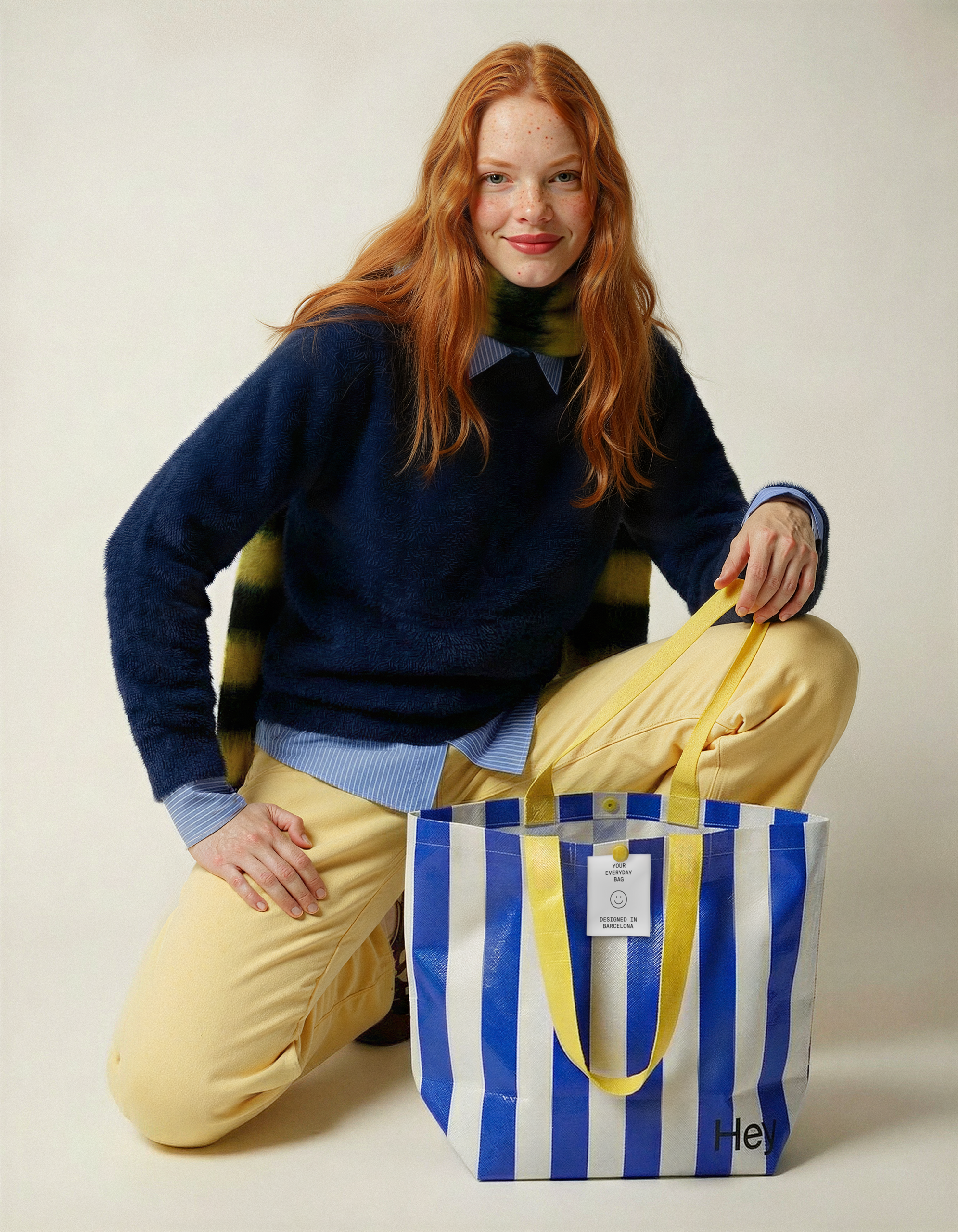
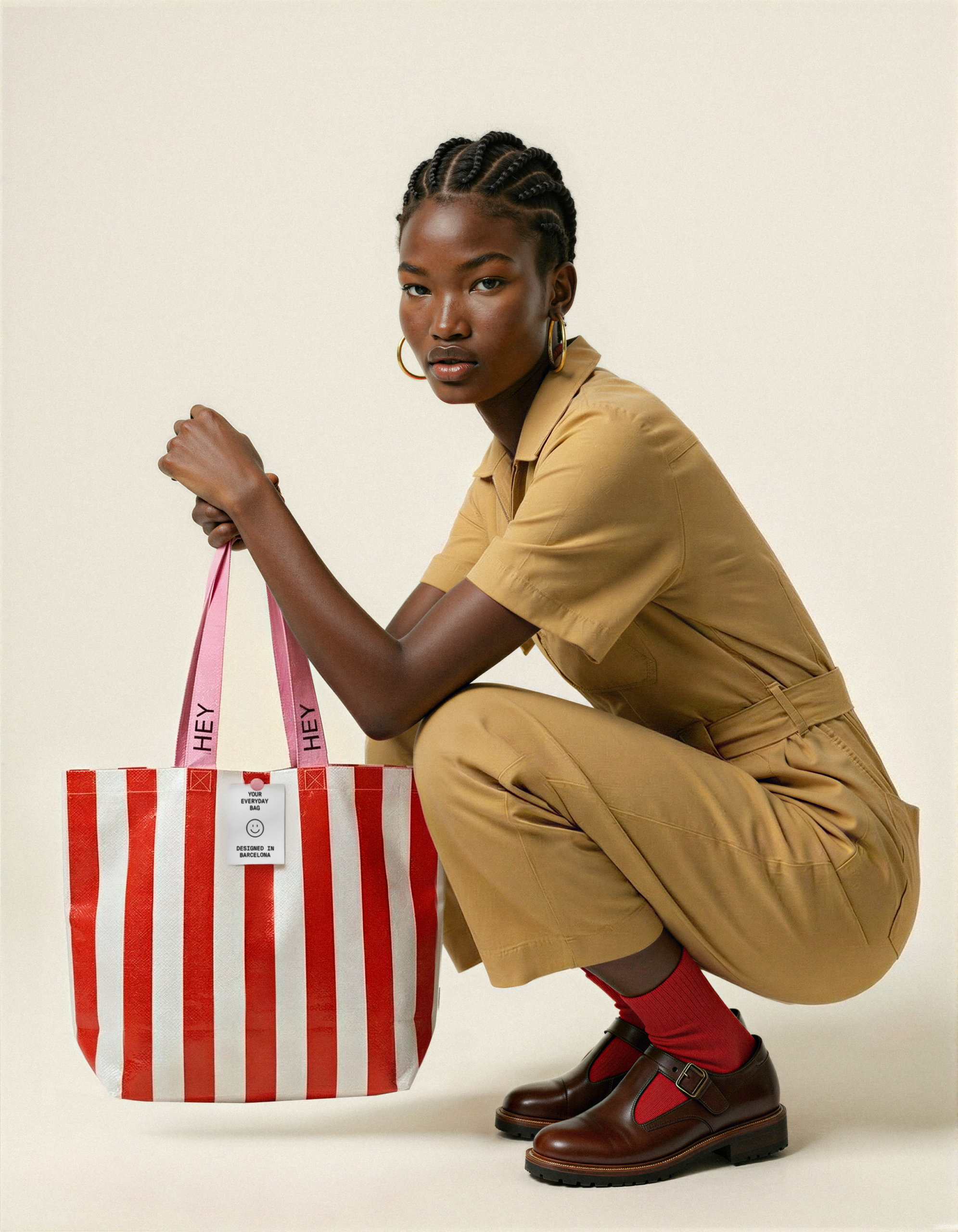
Veronica gives me two recent examples. The first, a bag collection. Hey already had the concept locked. Instead of opening Illustrator, the studio prototyped variations directly with AI.
"We already had the concept and visual direction in mind, but instead of using traditional design software, we prototyped the graphics and explored different variations directly with AI. It became part of the design process itself, allowing us to test ideas much faster and visualize possibilities almost instantly.”
Veronica Fuerte
The second, a photoshoot for the AI fashion-tech agency The Clueless. AI entered later, in the image production phase, sitting on top of an already-established art direction.
In both projects, the same line held. Veronica tells me:
"What remained entirely human was the strategy, the concept, the creative direction, the editing, and the final decision-making. AI helped us prototype, explore and produce. But it didn't define what the project was about or what we wanted to communicate.”
Veronica Fuerte
That's the framework. Direction is human. Execution can be assisted. Strategy lives nowhere near the model.

Forget the perfect prompt. Build your own tools.
How are working designers actually using AI in their day-to-day? Here's the use case the discourse hasn't fully clocked yet. Not "make me an image." Not "give me three logo options." Build the tool you wish existed.
Veronica uses Claude to build custom mini-applications that handle the repetitive parts of her motion design workflow. She runs them, exports the output, and finishes the work in proper software.
"In the past, you might have needed a developer or a technical collaborator to build those tools. Now, you can create them yourself, much more quickly.”
Veronica Fuerte
Sit with what that means for a small studio. Every "I wish there was a thing that did X" suddenly becomes a thing. Without hiring. Without waiting. Without having to explain what you mean across three meetings and a Notion doc.
The catch, of course, is the catch everywhere:
"AI gets me much further, much faster. But there is still a human layer before something is ready to ship.”
Veronica Fuerte
Why Hey Studio wrote AI into their client contracts
This is the part where I had to put my coffee down. Hey Studio's client contracts now include an AI clause. Two things it does. It stops clients from arriving with AI-generated artwork and treating it as a brief, or as the creative direction. And it protects the integrity of the work once Hey has designed it.
"AI can be a great tool for exploration and prototyping. But it shouldn't replace the strategic and creative thinking behind a project.”
Veronica Fuerte
So far? Zero pushback from clients. The clause just sets the tone.
It reminds me of Mike Monteiro's line:
"Design is a craft with an amazing amount of power. The power to choose. The power to influence.”
Mike Monteiro
The contract is craft too. The decision of what gets in the room and what doesn't, what counts as creative direction and what counts as a vibe board, what you're willing to let into the work and what you're not. That's the job. AI didn't change the job. It just made it more important to be explicit about it.
Inside Hey Lab: Hey’s weekly AI sandbox
What is Hey Lab, and why is it one of my favourite things any studio is doing right now?
Hey Lab is a weekly block where Hey Studio shuts the client work off, opens the studio up to experimentation, and sees what new tools can actually do. Not a one-off offsite. Not a quarterly "innovation sprint." Every week. Same time, same place.
Recent Hey Lab output? A lamp. Designed and prototyped entirely with AI. Now moving into actual production.
"What started as an experiment is now moving into production, which is exciting because it shows how these tools can go beyond digital outputs and become real objects. The pace of change is so fast that having dedicated time to explore feels essential.”
Veronica Fuerte
If your studio doesn't have a Hey Lab equivalent, this is your sign. The current pace doesn't reward studios that "get to it when there's time." There's never going to be time. You make the time, or the moment passes you.
AI slop has a tell
Why does so much AI-generated work still feel off, even when the technical execution is flawless? Veronica had the sharpest line in the whole conversation about this.
"AI is incredibly good at creating beautiful and convincing imaginary worlds. Sometimes the results look perfect, but you can immediately tell they were generated. I think people still want a connection to reality. Not everything should feel flawless or fictional.”
Veronica Fuerte
This is the authenticity tax. The internet is going to keep paying it as more generated imagery floods every feed. The fix isn't to reject the tools. It's to know what each one is actually for. Veronica again:
"We have many creative tools available today: AI, traditional design processes, photography, illustration and craftsmanship. The interesting part is choosing the right tool for each project rather than relying on a single process.”
Veronica Fuerte
That sentence is the whole game.
The one thing Veronica Fuerte will not hand to AI
What is the one thing Veronica Fuerte will never hand to AI, no matter how good it gets? I asked her directly. The answer landed:
"I would never hand over the final creative judgment. AI can help me explore ideas, generate options and speed up execution. But someone still has to decide what is right, what is wrong, what is worth pursuing and what should be left behind. For me, that's the most valuable part of design, and the part I enjoy the most.”
Veronica Fuerte
Or in House of gAi shorthand:
AI is your studio assistant, not your creative director. Know the difference.
"Perfect kills the soul"
How do you reconcile using a tool built specifically for precision with the belief that perfect kills the soul? Veronica returns often to that line, so I asked her.
"I see AI as one process among many, not the process. Every project needs something different. Sometimes a project benefits from the precision and perfection that AI can provide. Other times it needs something more raw, more human, or more handcrafted. I rarely use AI in isolation. Most projects move through different tools, techniques and stages. So while AI can generate something very polished, the final result usually comes from combining multiple processes and making human decisions along the way. For me, perfection isn't the goal. The goal is creating something meaningful.”
Veronica Fuerte
Read that paragraph twice. That's the thesis of the whole talk.
AI isn't here to make perfect work. It's here to give you more raw material to shape into work that means something. The polish is cheap. The meaning is yours.
How to attend: Veronica Fuerte live on June 17, 2026
When and where can you join Veronica Fuerte's talk? Veronica is joining the House of gAi community live on Wednesday, June 17, 2026, at around 5pm Barcelona time (CET). That's 11am ET / 8am PT in the US, mid-morning in Mexico City, and early evening across the UK and Europe.
We're keeping it conversational. A short presentation showing real Hey Studio work. A discussion between Veronica and me about how all of this fits together in an actual practice. Plus your questions. Recorded for anyone who can't make it live.
If you've been waiting to hear from a designer who is actually using AI well, who has clearly thought about it, and who is not trying to sell you a hype reel or a course, this is the one to be in the room for.
WATCH THE RECORDING OF THE EVENT INSIDE THE VIP CREATIVE FUTURES HUB
Frequently Asked Questions
What is Veronica Fuerte's talk about?
Veronica Fuerte, founder of Hey Studio in Barcelona, joins House of gAi for a live conversation about integrating AI into a real design studio practice. Topics include prototyping in AI, building custom motion tools in Claude, why she wrote an AI clause into her client contracts, and how Hey Lab (her weekly experimentation block) works.
When is the talk?
Wednesday, June 17, 2026, at around 5pm Barcelona time (CET). That is 11am ET / 8am PT in the US, mid-morning in Mexico City, and early evening across the UK and Europe.
Who is Veronica Fuerte?
Veronica Fuerte is the founder of Hey Studio, a Barcelona-based graphic design studio known for precise, vibrant, vector-led identity work. She has been integrating AI into Hey Studio's practice across motion design, prototyping, and image production.
Is the session recorded?
Yes. The talk will be recorded for House of gAi VIP community members who cannot join live.
How do I attend?
Join the Creative Futures Hub to RSVP and attend. Existing members can RSVP directly through the meetup link inside the community.
About the author: Anthony Wood is the founder of House of gAi, an educational platform helping designers integrate AI into their creative process. He runs the AI Branding Masterclass and hosts monthly talks with leading creatives inside the Creative Futures Hub community.