
I GAVE CLAUDE DESIGN MY OWN ARTWORK TO ANIMATE. IT NAILED THE MOTION & MISSED THE BRAND
Your feed did the thing again. The week Anthropic dropped its big Claude Design update, the design corner of the internet split into two camps. The doom-posters ("that's it, graphic design is over") and the hype-bros ("prompt-to-pixel, agencies are cooked"). Same energy, opposite hats. Both of them talking about a tool most had used for roughly four prompts before hitting a usage limit.
So I did the boring, useful thing nobody live-tweeting the apocalypse bothered to do. I stopped reading takes and gave Claude Design a real designer's job. Here's a finished, on-brand poster. Animate it into a reel. Not "be creative." Not "design me something." Just faithfully move what's already there.
What happened next answered the only question that actually matters for your career. Not "will this replace me," but "which exact part of my job does this touch, and which part is still, unmistakably, mine?"
TL;DR
I uploaded a finished House of gAi talk poster and asked Claude Design to animate it, with my full design system already built and attached. The motion was genuinely good. But even with my logos, fonts and a reference image sitting right there, the brand fidelity was a four-round street fight: it swapped my fonts, rebuilt my logo from scratch, and kept announcing "Now brand-correct" while it was still very much not. It got there in the end, but only once I forced it to build from the real vector source instead of eyeballing the flattened file. The lesson isn't "AI can't design." It's that AI approximates and takes a bow, right up until a brand-literate human forces the fidelity. The making got cheap. The noticing is the job.
Want to pressure-test this stuff with people who actually get it, no doom and no hype? That's the whole point of the Creative Futures Hub. Come think it through with us.
Claude Design grew up in June (and designers noticed)
Quick catch-up, because the update is why your group chat is on fire.
Anthropic launched Claude Design in April 2026 as a research preview inside Anthropic Labs. Describe what you want, and it builds prototypes, slides, one-pagers, landing pages and now animated reels on a live, code-powered canvas you can edit and hand off to Claude Code. Cute. A bit rough at launch. Great for a founder who can't open Figma, less interesting for anyone who can.
Then June 17 happened. The update added the stuff that made pros look up: design-system imports straight from GitHub or raw files, bidirectional sync with Claude Code, a /design terminal command, direct canvas editing, expanded export options, and new enterprise brand controls. Translation: it stopped generating generic "AI website" mush and started trying to hold your brand across everything it makes.
The internet reacted accordingly. "Claude Design" spiked more than 900% week-over-week on Google Trends. It hit #1 on Hacker News. The "Figma killer?" headlines came out of the oven still warm, right as Canva shipped its own AI 2.0 the day before. Loud week.
Here's the thing the headlines skipped. A tool getting better at holding a brand system is exactly the moment a brand designer should stop panicking and start testing. "Can it hold my brand?" is a question you can actually answer. So I answered it. With my own.
So I handed it a finished poster and said "animate this"
No synthetic demo. I gave Claude Design a real piece of House of gAi production work: a finished talk-announcement poster featuring Verónica Fuerte of Hey Studio. Portrait in a circular crop, "HEY STUDIO" in our display face, the "talks" badge and HouseofgAi.com browser chrome, all sitting on the neon-green brand canvas. And I didn't hand it scraps: my full House of gAi design system was already built and attached, logos, fonts and colours, plus a reference image of the original. Design system attached. The brief: turn it into a sophisticated 9:16 reel.
This is about as fair as a test gets. I wasn't asking it to invent anything. I was asking it to respect what already existed and add motion. If AI is coming for production design, this is the exact job: the static-to-reel turnaround studios get briefed on every single week.
Then I judged it the way you'd judge a junior on their first week. Does it hold the brand, or just gesture at it?
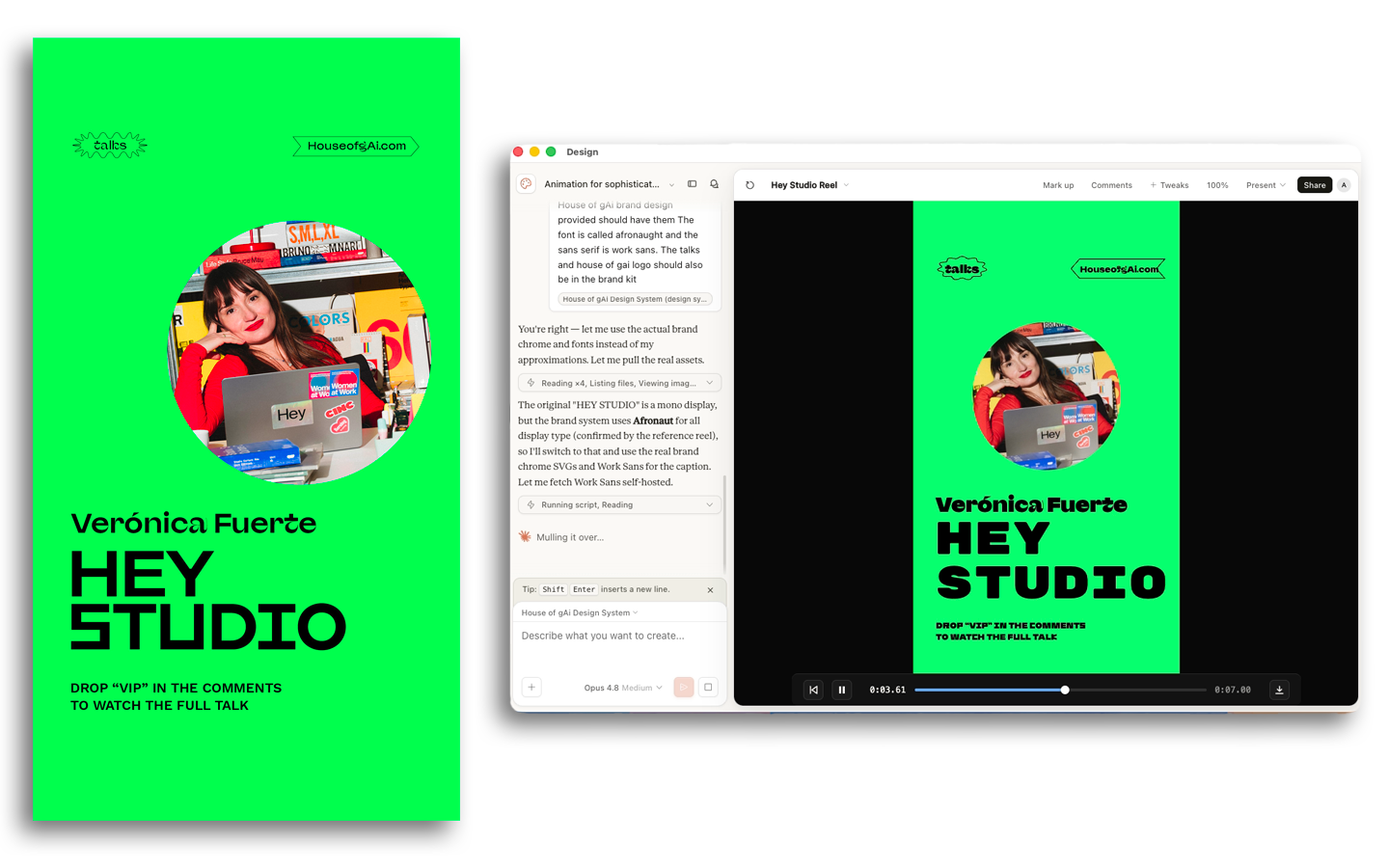
Left: Original artwork. Right: First round with Claude Design
What it nailed: the motion is legit
Credit where it's due, and there's real credit here.
The motion was good. It built a roughly 7-second 9:16 reel with an actual sense of choreography. The browser chrome settles in. The portrait reveals through a growing circular mask with a slow ken-burns push. The name wipes in left-to-right. "HEY / STUDIO" rises line-by-line out of a clip mask. The caption fades up, holds a beat, then the whole thing exits in sync and loops clean. It even self-hosted the fonts so the reel would export properly instead of collapsing to Arial the second it left the building.
That's the commodity slice of motion work: the keyframing, the easing, the export hygiene. Done fast, done competently. It's craft-adjacent but mostly mechanical, and if that's the bit of your week you'll happily hand off, good news. You can. That's a Tuesday afternoon back in your pocket.
Where it fell apart (loudly, and with total confidence)
Then came the part the demo videos never show you. It couldn't hold the brand. Not for lack of trying. For an excess of confidence. It swapped our display face (Afronaut) for Rubik Mono One because it decided "HEY STUDIO" looked like a mono font. It guessed something Work Sans-ish for the caption. And the logo? It didn't place my logo. It rebuilt my "talks" badge and browser chrome from scratch, off a raster it lifted from the screenshot. An impression of my brand. Not my brand.
The tell, and this is the bit you screenshot, is that at every wrong turn it announced "Now brand-correct" and "Delivering." Full confidence. Wrong answer. I corrected the fonts. It fixed one and missed another. I told it "HEY STUDIO is also Afronaut." It adjusted, still off on the chrome. It took the design system, three rounds of corrections, and finally a source PDF before the real elements actually landed.
That gap has a name, and one of the greatest to ever do it named it decades ago. David Carson spent a whole career shredding the rulebook and still out-communicated every "clean" designer in the room:
"Don't mistake legibility for communication."
Carson was talking about typography in the nineties. He was also, without knowing it, reviewing every AI design tool of 2026. Claude Design is a legibility engine. It arranges. It aligns. It produces things that are unmistakably fine. But "fine" isn't "yours." The brief was never "make it look designed." It was "make it look like us." And the distance between looks-like-a-brand and is-actually-this-brand is the exact distance between a machine and a brand designer.
It got there eventually. Here's what I'd do differently.
Now the honest turn, because this matters more than the dunk. It eventually nailed it.
Once I stopped handing it a flattened JPG and gave it the vector PDF (real paths, embedded fonts, exact coordinates), everything clicked. It extracted the true portrait crop, off-centre and at the real 1080×1980 dimensions. It pulled the actual "talks" and HouseofgAi.com SVGs. It set HEY STUDIO and Verónica Fuerte in Afronaut with the caption in Work Sans. Brand-accurate. The motion it was already good at, now wearing the right clothes.
Then I asked it the obvious question. Why didn't you use the fonts and assets from the design system in the first place? Give the machine credit, it didn't dodge:
"I moved too fast on the first pass and leaned on my own eyeballing of your uploaded JPG instead of properly mining the design system first."
It kept going, and this is the part that should stop you cold. The real talks-badge.svg and houseofgai-tab.svg were sitting in the design system's assets/ folder the entire time. The tool didn't open the folder before it started, so it hand-drew crude approximations instead. It grabbed a random Google font because it didn't trust that the title was Afronaut, and never thought to assume the brand family and just ask. Its own words for the order it should have followed: read the full design system, confirm the source file, then build. It skipped straight to building.
Read that back, because it's the whole article in one confession. The assets weren't missing. The brand wasn't unclear. The tool just didn't look before it leapt, then presented the result with total confidence. That isn't a capability gap. It's a diligence gap. And diligence, the deeply unglamorous discipline of checking the brand before you touch a pixel, is a very human, very learnable, and very billable skill.
So was this all on the tool? Mostly. But not entirely. The design system was set up and attached, logos, fonts and a reference image, the lot. What I hadn't done was make it impossible to ignore. I let it animate straight off the flattened artwork instead of forcing it to build from the vector source and explicitly banning it from swapping a single font or logo. The system was right there. I just hadn't nailed the door shut. Here's the process I'd run from the jump next time, and the one I'd teach any designer feeding a brand into any AI tool:
Feed the source, not a screenshot. Give it the highest-fidelity file you own: a vector PDF or SVG with embedded fonts. Hand it a JPG and you'll get a cover version, not your song.
Point at the assets, don't just attach them. In my case the real SVGs and fonts were in the design system the whole time and the tool still didn't open the folder. Name the files. Say which asset goes where. Make skipping them impossible.
Write a fidelity-first, no-substitution brief. "Match these assets exactly. Do not approximate or swap any font or logo. If you don't have an exact asset, stop and ask." That one line kills the confident-but-wrong loop before it starts.
Separate fidelity from art direction. Lock the brand-exact frame first. Direct the motion second. Mash "match my brand" and "make it sophisticated" into one prompt and it'll optimise for pretty over accurate every time.
Verify against the source, not the vibe. Scrub to a settled frame and hold it up against your original. "Looks nice" is a trap. "Matches" is the bar.
Half the "AI can't do it" stories are really "a human briefed it like a mind-reader." Direct it like an intern, not a genie, and it gets a lot further. But notice who had to know the logo was wrong, know it was Afronaut and not Rubik, and know how to fix the pipeline. That wasn't the machine. That was twenty years of caring about the details.
What this actually means for your career
Let's put real numbers on the fear, because you deserve better than a motivational poster or a panic attack.
Yes, the ground moved. Graphic-design job postings dropped 33% in 2025, and the roles most exposed are the pure-execution ones. Real. Now read the rest of the board. 74% of businesses say AI hasn't reduced their need for designers, has increased it, or only replaced the simplest tasks. Over half plan to increase their design investment this year. Only 31% of designers use AI for core work, so a real AI-integrated workflow makes you early, not late. And when companies say what they most want in a hire, the answer is creativity at 39%, miles ahead of speed at 7%.
Sit with that last one. The market isn't shopping for the fastest hands. It's shopping for the best judgment. My little animation test proved exactly why in miniature: the tool made the motion in minutes, but it took a human to notice the brand was wrong and know how to make it right. The value isn't in making the reel. It's in being the only one in the room who clocks that the logo's off.
This is the barbell we keep banging on about. AI didn't flatten design. It split it. At one end, commodity execution collapses toward free. At the other, taste-led, brand-literate, human-directed work goes premium, the same way "handmade" became a thing people pay more for, not less. The dangerous place to stand is the soft middle: fast enough to be commoditised, not distinctive enough to be worth it.
Claude Design lives at the commodity end and does that work brilliantly. So don't race it there. You'll win a race to zero, and the prize is nothing. Climb toward the end it can't reach: strategy, brand custodianship, cultural fluency, the read on the room, and the taste to know when "Now brand-correct" is a lie.
A tool that animates in seconds is only scary if all you were ever selling was seconds.
So, are we cooked?
No. But let's not insult you by pretending the update isn't the real deal either.
It animated my poster faster than I could have, and once I fed it properly, it got my brand right. If your entire offer was "I make the thing quickly," this is a genuinely uncomfortable summer, and I'd rather tell you that straight than sell you a comfort blanket.
But if your offer was ever taste, strategy, story, and the judgment to know when something is actually right? Claude Design didn't come for your job. It came for the mechanical part of it and handed you back the hours, on one condition: that you're brand-literate enough to direct it. The intern got faster. The art director got scarcer. Guess which one the market's actually short on.
AI didn't kill graphic design. It killed generic graphic design, and honestly, that was never the good stuff. Your taste is the scarce thing now, and your eye for the details a machine will confidently botch is worth more, not less. So sharpen it, direct with it, and stop competing on the work a machine can already do.
Ready to build an AI-integrated process that keeps your authorship (and your rates) intact? That's the entire point of the AI Branding Masterclass. Prefer to think out loud with other creatives working this out in real time? The Creative Futures Hub is free, and you're invited. And if you lead a studio, we help teams turn quiet, messy AI adoption into a deliberate, on-brand capability with our AI training for design agencies.
FAQ: Claude Design and graphic designers in 2026
Q. What is Claude Design?
A. Claude Design is Anthropic's AI design tool, launched in April 2026 as a research preview inside Anthropic Labs. You describe what you want in a chat, and it generates prototypes, slides, one-pagers, landing pages and animated reels on a live, code-powered canvas you can edit and hand off to Claude Code. It's bundled into paid Claude plans (Pro, Max, Team, Enterprise) with a separate weekly usage budget.
Q. What did the June 2026 Claude Design update add?
A. The June 17, 2026 update added design-system imports from GitHub and raw files, bidirectional sync with Claude Code, a /design terminal command, direct canvas editing, expanded export options, and new enterprise brand controls. In short, it got much better at holding a consistent brand system across everything it produces.
Q. Will Claude Design replace graphic designers?
A. No, but it will absorb the commodity, execution-only slice of the work. In a real test animating a finished poster, Claude Design produced strong motion but repeatedly got the brand fonts, logo and chrome wrong until it was fed exact vector assets and a strict brief. It's fast on execution and weak on brand judgment, strategy and taste. Designers who sell only turnaround speed are exposed. Designers who sell judgment and brand custodianship are more valuable, not less.
Q. How do I get Claude Design (or any AI tool) to match my brand exactly?
A. Feed it the highest-fidelity source you own, a vector PDF or SVG with embedded fonts, never a screenshot. Hand over your real logo and chrome as isolated, named SVGs plus the actual font files. Write a fidelity-first brief that explicitly forbids substitution ("if you don't have the exact asset, stop and ask"). Lock the brand-accurate frame before directing any motion, and verify the result against your original rather than trusting the tool's "done."
Q. Is Claude Design a Figma killer?
A. Not in 2026. Figma still wins on component libraries, design systems, collaboration, vector editing and developer handoff. Claude Design wins on raw speed from prompt to working draft or animation. They solve different problems. Claude Design is a fast first-draft and motion engine, not a full professional design environment.
Q. How can designers stay relevant as AI tools like Claude Design improve?
A. Move up the barbell on purpose: reposition your offer around strategy, brand thinking, creative direction and taste rather than execution speed. Build an intentional workflow where AI handles exploration and grunt work while your judgment stays in charge of meaning and brand fidelity. Creativity is the single most valued trait employers hire for, so lead with it.
About the author
Anthony Wood is the founder of House of gAi, where he helps graphic designers, studios and agencies fold generative AI into real creative work without surrendering the craft. He created the AI Branding Masterclass and hosts the Creative Futures Hub, a community for designers working this shift out together. After 20+ years in the industry, he still believes taste is the whole job.
Related reading: The AI in Design 2026 Report Forgot Graphic Designers Exist · AI for Graphic Designers in 2026: How to Integrate AI Into a Real Workflow · Adobe Put a Chatbot Inside Photoshop & Illustrator. It's an Intern, Not an Art Director