
YOUR STUDIO ISN’T LOSING TO AI. IT’S LOSING TO ITSELF
The big agencies are making enormous bets on AI infrastructure. Most boutique studios are still arguing about whether Midjourney counts as "real" design. Here's what's actually going on, and where the real opportunity sits.
I was on a call last week with a full-service branding studio. Nearly three decades in business. FMCG clients. Tight processes. A strong roster. The kind of studio that has survived every industry shift—the digital pivot, the brand strategy boom, the in-house creative revolution—and come out the other side with its reputation intact. The founder's question stopped me cold.
He'd been reading about Landor, Interbrand, FutureBrand—the big global players—and their move toward AI-powered subscription models. Setup cost, monthly retainer, clients accessing a brand generation system the agency controls. He wanted to know: is this the future?
My honest answer? The model is real. But the way most studios are thinking about it is all wrong.
Let's be honest about the big agencies first
In October 2025, WPP launched WPP Open Pro: a self-serve platform that lets brands plan, create and publish entire campaigns without an agency engagement. Landor has been quietly building what they call an "Intelligent Brand System": AI agents that audit brand touchpoints, score them against competitors, and enforce guidelines at scale.
The breathless trade press coverage would have you believe this is the definitive end of the boutique studio. That WPP has cracked it. That the holding companies win.
Here's my sceptic's read: the big agencies have been "cracking it" for thirty years.
They said data would eliminate creative intuition. They said programmatic would replace media planners. They said the in-house agency movement would collapse their model. And yet, studios like the one I described are still running full-service branding agencies with multinational clients, nearly three decades after they started.
The moves WPP and Landor are making are real and significant. But they're built for enterprise clients with complex, global brand ecosystems. The mid-market—the 20-person studio, the specialist branding agency, the design firm with deep category knowledge—is not their target. It never was. And that, as it turns out, is where the actual opportunity for AI integration in creative agencies lives.
Why are creative agencies solving the wrong AI problem?
Here's what I see when I talk to creative agencies about AI: they're solving the wrong problem. The conversation is almost always about output. Faster image generation. Better mockups. Quicker pitch decks. Which tool produces the most photorealistic renders. Whether AI can replace the junior retoucher.
That's workflow efficiency. And yes, it matters. But it's not the transformation.
The studios that are pulling ahead aren't asking "how do we do what we already do, faster?" They're asking "what can we now do for clients that we couldn't justify billing for before?"
Those are completely different questions. And they lead to completely different business models.
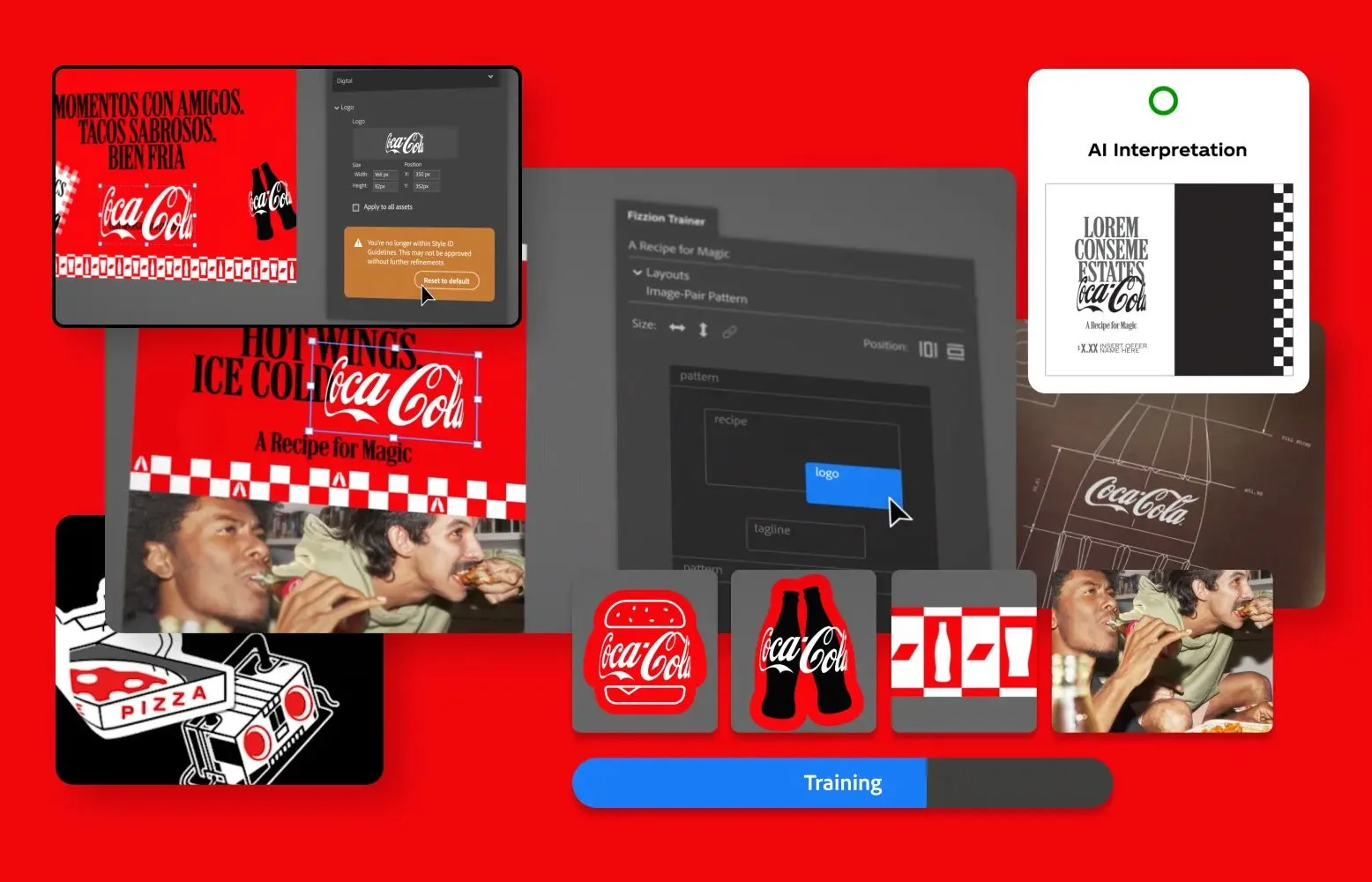
Case in point: Coca-Cola and Adobe co-developed Project Fizzion—an AI system that learns from how designers work inside Creative Cloud tools and encodes their creative decisions into a machine-readable format. Their 2024 AI-generated holiday ad was publicly savaged by the creative industry: “soulless," "uncanny," technically inconsistent. And then Coca-Cola released their consumer testing results: it was one of their top-tested ads in history, outperforming internal benchmarks across multiple continents.
You can argue about aesthetic quality all day. But the actual question the industry should be asking is: what does it mean when the creative community's primary objection and the client's metric outcomes are completely disconnected?
It means we're having the wrong argument. Output quality is a solvable problem, it gets better every six months. The real question is what AI makes possible that wasn't possible before.
Tibor Kalman—the provocateur behind M&Co, one of the most interesting studios of the 20th century—put it plainly: "Designers are trained to speak in a visual language. But that doesn't give us the right to stop thinking."
AI doesn't solve the thinking problem. It amplifies it. Studios that are only chasing workflow efficiency are building a faster horse. The real question is: what do you do when you can go anywhere?
What are creatives missing about AI? (It's not the images)
There's a pattern I see with creative teams when they start exploring AI. They head straight for the image generators. Midjourney, Firefly, Flux: the visual tools. Which makes sense. It's where the most immediately visible results live. The jaw-drop moment. The thing you can put in a slide. But it's also where they stop.
And in stopping there, they miss what is arguably the most transformative part of the whole stack.
LLMs—the Claude, ChatGPT, Gemini layer—aren't primarily image tools. They're thinking tools. Research tools. Strategy tools. Systems that can ingest a 40-page brand strategy document, hold it in context, cross-reference it with competitor positioning, analyse Reddit threads and Google reviews, identify the emotional white space in a category, and surface insights that would have taken a strategist three weeks and a significant budget line to produce.
That studio's strategist mentioned her team was spending hours on manual Google searches for brand and audience research… that's the gap I'm talking about. Not the gap in image quality. The gap in strategic horsepower.
Most creatives are looking at AI and seeing a better Shutterstock. What they should be seeing is a better thinking partner.
What is LLM literacy and why does every creative agency need it?
Before Figma Weave. Before custom Brand GPTs. Before any conversation about subscription models or AI brand systems. Literacy.
The single most impactful thing any creative agency can do right now—before any discussion of AI training for creative teams or tool adoption—is get the whole team genuinely conversational with an LLM. Not "I've used ChatGPT to write an email once." Conversational. Collaborative. Able to use it as a thinking partner, not a Google replacement.
Most teams are nowhere near this. Some aren't using AI at all. Some use it sporadically, for the obvious tasks, and get mediocre results because they're not engaging it properly. And a few (a very few) are having productive back-and-forths with AI that improve their work, their thinking, and their output.
The gap between these groups is not technical skill. It's fluency. The studio that gets its whole team LLM literate—where the strategist is using it to stress-test positioning, the CD is using it to pressure-check creative against the brief, the account director is using it to prep for client presentations—that studio starts operating differently. Not because any individual person is smarter. Because the collective intelligence of the team gets a significant upgrade.
AI is a multiplier. Bring taste, you get a bigger studio. Bring nothing, you get very fast nothing.
Cyborg mode. Activated across the whole agency.
The flip: AI doesn't let you do less. It lets you do more.
Here's the take that most of the AI conversation in our industry is missing. The dominant narrative is cost-saving. AI reduces headcount. AI eliminates junior roles. AI lets you do the same work with fewer people. And yes, there's truth in that efficiency gains are real.
But that framing is fundamentally defensive. And it leads studios toward a race to the bottom. The more interesting question is: what can you now offer that you couldn't justify before?
Think about how brand and creative strategy has historically worked. You create one campaign. You target a broad demographic. Maybe you do two or three variations if the budget stretches. Because granular, audience-specific creative is expensive — in research time, in production time, in the sheer human hours required to do it properly.
AI changes that equation completely.
A studio with real AI integration can now look at a client's audience data, identify the meaningful subsets within it, build out specific strategic insights for each, and create tailored creative that speaks to a 38-year-old suburban mum differently to how it speaks to a 24-year-old urban renter… even within the same campaign. Not because they've scaled up their team. Because they've scaled up their process.
That's not a cost saving. That's a capability expansion. And it's a completely different conversation to have with a client.
"Our fees are the same but we're delivering more targeted work" is a good story. "We can now build you a subscription-based brand system that generates compliant, on-brand outputs for your team to use" is a great story. The Landor model, appropriately scaled for a boutique studio, is absolutely achievable, and frankly, more compelling coming from a specialist agency with decades of category knowledge than from a holding company platform built for global enterprise.
So what does your studio actually build?
Not the subscription model. Not yet. The foundation first.
One: LLM literacy across the whole team. Not a half-day workshop with a motivational slide deck. A real, structured introduction to collaborative AI conversation: how to prompt properly, how to use AI as a thinking partner rather than a search engine, how to build basic automations that save hours across the week. This is the baseline. Without it, everything else is a gimmick.
Two: AI integrated into your existing processes. Most agencies with good practices have documented workflows for brand strategy, for creative development, for client services. The question is: where in those workflows does AI add real horsepower? Usually it's in research, in briefing, in concepting, in iteration. Map it, test it, make it repeatable.
Three: Build the architecture, not just the output. Think of it less as "adopting tools" and more as building a design machine. This is where AI integration for creative agencies gets interesting — and where tools like Figma Weave come in.
Weave is a node-based, non-destructive workflow platform that lets you build repeatable creative pipelines. Instead of a designer producing one-off outputs, you're constructing a system: connect your brand references, set your visual parameters, generate variants at scale. Change one variable — a demographic, a product colourway, a regional market — and the system reruns with everything else intact. It lives inside Figma (which acquired Weave at the end of last year, a signal worth paying attention to), which means it sits where your creative team already works.
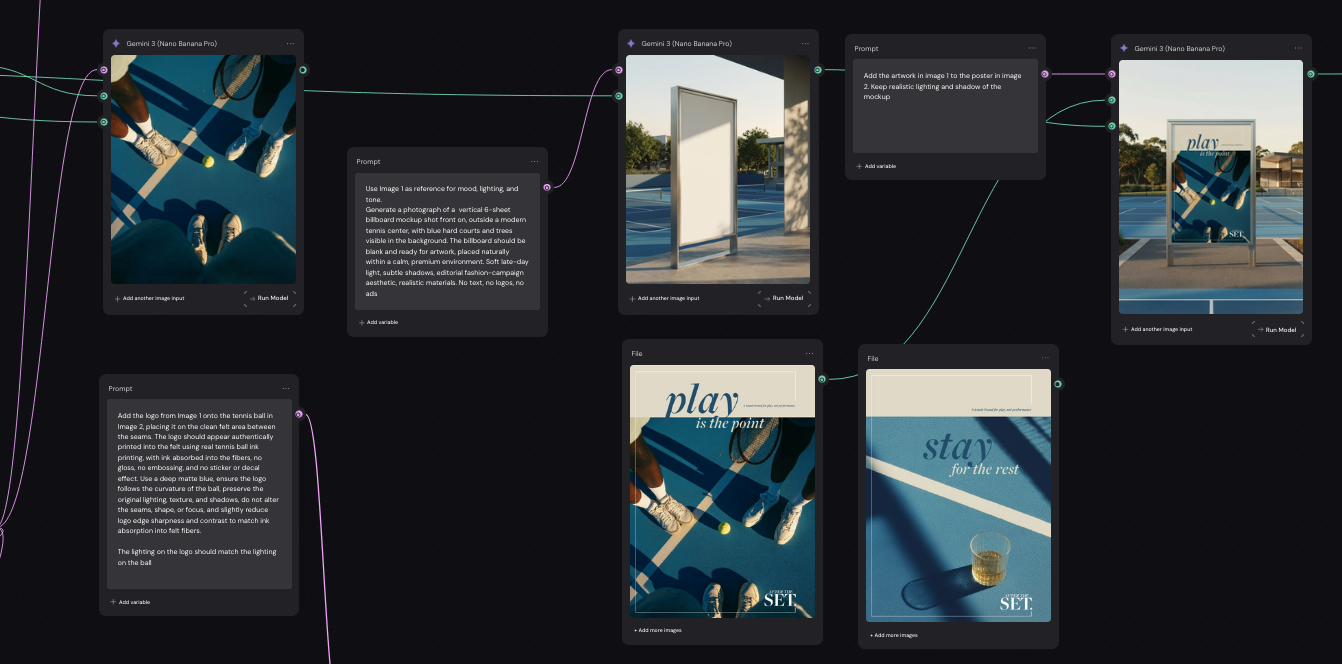
For a studio with deep client knowledge, this is the path to what Landor is building for enterprise, scaled appropriately for a boutique. You set up the brand system. You build it around the client's visual language, tone, and strategic guardrails. And you give the client controlled access to generate their own compliant outputs—social assets, campaign variants, internal comms—while you retain the architecture. The IP stays yours. The ongoing access is the subscription. The setup is the engagement fee.
That's not a hypothetical future model. It's buildable now. And it's a completely different conversation to have with a client than "here's our day rate."
The studios that win won't be the ones with the most tools
I'm sceptical that Landor's AI brand system will look exactly the way they're describing it in five years. The big agencies have a track record of announcing transformations and quietly returning to business as usual.
But the underlying shift—from project-based billing to systems-based value—is real. The efficiency gains from AI are real. And the opportunity for boutique studios to build something proprietary, something that leverages their specific expertise and client knowledge, is very real.
The studios that are going to lead the next decade aren't the ones who adopted the most tools. They're the ones who built real AI literacy, mapped it onto genuine process, and used it to offer clients something they couldn't get elsewhere.
That takes leadership. It takes a willingness to invest in AI training for creative agencies before it's obvious that training is the answer. And it takes an honest read on what problem you're actually trying to solve.
Workflow efficiency is fine. But brand architecture is where the value lives.
If this landed—and you're thinking about what this actually looks like for your agency—that's exactly the conversation we start with at House of gAi. No deck, no pitch. A strategy call where we look at your team, your processes, and your clients, and figure out what the right move is. Even if it turns out the right move isn't us.
Frequently asked questions
Q. What is an AI brand system for creative agencies?
An AI brand system is a set of documented brand rules, visual references, and strategic guardrails encoded into an AI-powered workflow. Rather than a static PDF style guide, it's a living system that can generate on-brand outputs — social assets, campaign variants, copy — consistently and at scale, while retaining the agency's creative logic and IP.
Q. How should a boutique creative agency start integrating AI?
Start with LLM literacy across the whole team before touching image generators or automation tools. Getting every department — strategy, creative, client services — fluent in collaborative AI conversation is the foundation that makes everything else work. From there, map AI onto your existing documented processes before building anything new.
Q. What is Figma Weave and why does it matter for branding studios?
Figma Weave is a node-based, non-destructive workflow platform that lets creative teams build repeatable AI-powered pipelines — connecting brand references, visual parameters, and generation tools into a single editable system. Figma acquired it in late 2024, making it a strong long-term bet for studios already working in Figma. For branding agencies, it's the most practical current path to building a scalable brand output system without enterprise-level infrastructure.