
CLAUDE DESIGN DIDN'T KILL DESIGN. IT KILLED THE PART YOU SHOULDN'T HAVE BEEN DOING.
The question every designer messaged me last week was the same one Wall Street was asking with its wallet: is this the one? Anthropic released Claude Design on April 17. Figma's stock dropped 7% the same day. Adobe slipped 2.7%. Mike Krieger, Anthropic's CPO, quietly resigned from Figma's board three days before the launch… which is the corporate equivalent of leaving the dinner table before the food hits the floor.
By Monday morning, the discourse had split into two camps. The TikTok hot-take lane was already writing eulogies for Figma and Adobe. The thoughtful corner of Medium and Substack was writing something closer to a reckoning. And somewhere in the middle, in every boutique studio and freelance DM, designers were quietly asking themselves if their rate card still made sense.
So I did what we always recommend at House of gAi. I ignored the noise and ran the thing myself.
What Claude Design actually is (the short version)
Claude Design is Anthropic's new AI design product, running on Claude Opus 4.7. You feed it a brand system — colours, typography, reference assets, a codebase if you have one — and it generates polished design work from natural-language prompts. Posters. Landing pages. Carousels. Pitch decks. Interactive prototypes with voice and video and shaders, if you're feeling spicy.
You refine through conversation, inline comments, or custom sliders Claude builds on the fly. You export to Canva, PDF, PPTX, standalone HTML, or hand the whole bundle off to Claude Code to build it for real. It sits in an uncomfortable new category between Figma, v0, and Canva — and Canva is literally a launch partner, which tells you where the walls come down and where they stay up.
This is not Midjourney competition. This is not going to replace your illustrator. But if you're a graphic designer who's ever spent three rounds nudging a layout for a client who couldn't articulate what they actually wanted, Claude Design knows exactly where you live.
I ran it on a real brand brief. Here's what happened.
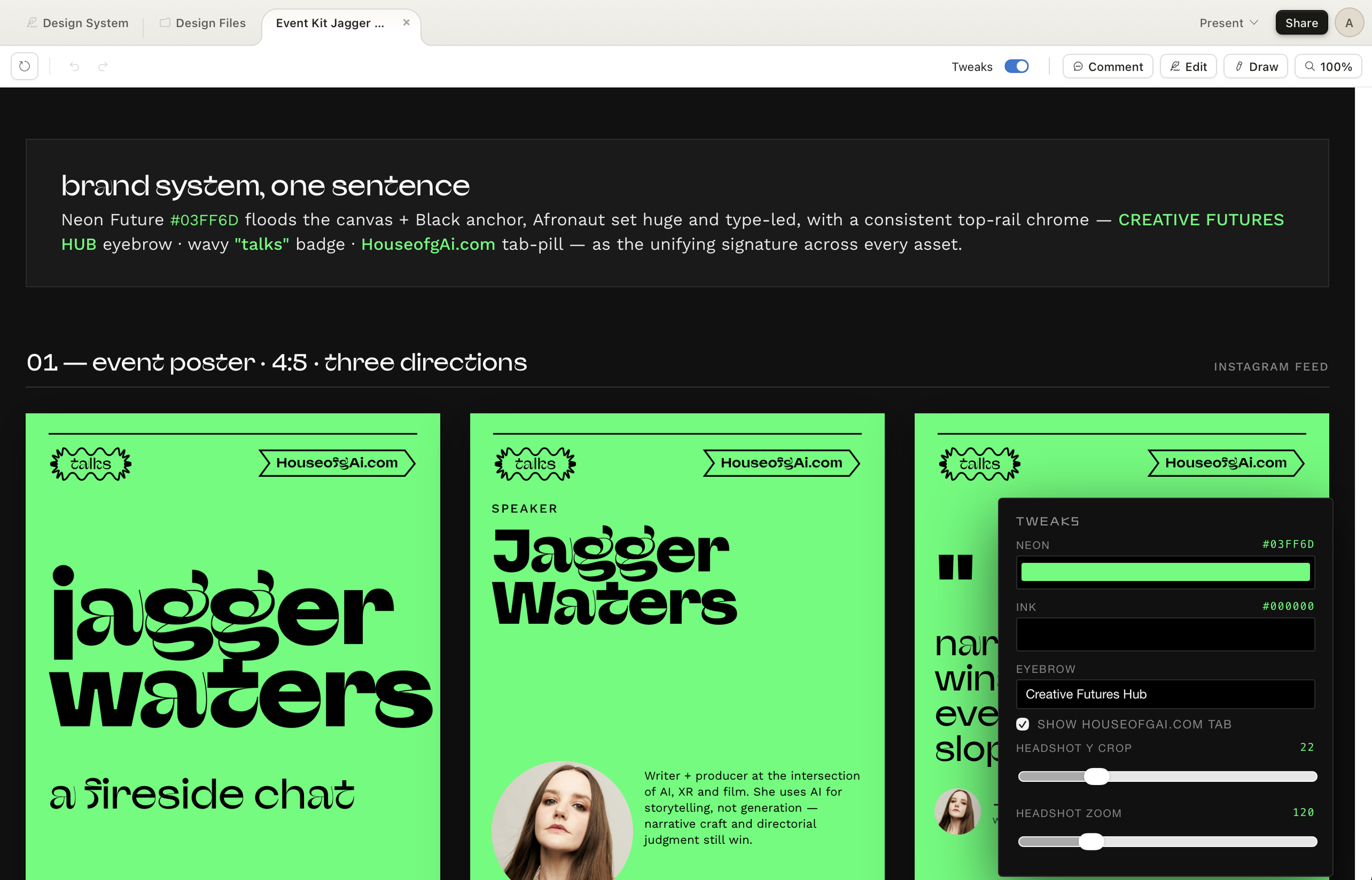
I fed Claude Design the House of gAi brand system — our colour palette, our custom font, our reference posters from previous Creative Futures Hub events — and asked it to build a full event identity kit for our next fireside chat. Five assets. One brand. No shortcuts.
Let's be real about the first ten minutes. The setup was bumpier than it should have been, and it was entirely my fault. I don't have a fully fleshed-out style guide for House of gAi. I have the vibes, the assets, and a lot of opinions — but not a single PDF a tool can read cover to cover without asking me to fill in the blanks.
That's a me problem, not a Claude problem. And it was a useful reminder that I'll probably never forget: brand infrastructure matters more in an AI-native workflow, not less. If your brand lives in your head, AI can't apply it. If it lives in a documented system, AI can apply it while you do something more interesting.
Once I found the rhythm, though? It clicked. Hard. I could highlight any element on the canvas, type a tweak, and Claude actually listened. Not "regenerate the whole thing and pray." Actually listened. That surprised me more than anything else in the test. It felt less like prompting an AI and more like directing a very fast, very literal junior designer who didn't take feedback personally.
The posters landed. The carousel was on brand. The speaker card was better than I expected for a first pass. There are small details I'd still refine as a designer — the kerning wants a tighter pass, one layout direction was a bit too clean, the hierarchy got confused on the EDM header. But it was a first pass. Always will be.
Here's the part that's going to make every designer sit up.
Testing out Claude Designer on a real design project
Design was never the comps
That line isn't mine. It comes from Christopher Noessel, a 20-year UX veteran who published a piece last week about being overwhelmed when on the receiving end of a design dump that Claude Design produced for him. He's a designer, he writes, and he couldn't tell you which comp was best or why, because he had no shared understanding of the tradeoffs that led there. He just had output.
His argument is the smartest thing written about Claude Design so far, and every graphic designer should absorb it:
The comps were never the design. They were the artifact of design.
The design — the actual thing you're being paid for — is the model you build in your head. The one that holds the client's goals, the user's friction points, the brand's voice, the constraints of the production pipeline, the thousand tiny judgment calls that add up to a thing worth making. That mental model is what lets you defend a decision, adapt it when the brief shifts, and know which direction is right when the client says "I don't know, make it pop."
A comp dump skips the model and delivers the artifact. You get something to look at. You don't get something to critique, defend, or build on.
And here's where it gets pointed for us as graphic designers. Most of our clients have never known the difference.
The first three rounds are now free. What are you charging for?
For twenty years, a huge chunk of what graphic designers have charged for has been the first three rounds. The initial explorations. The layout options. The type pairings. The colour studies. The wireframes. The "here are three directions, which one speaks to you" deliverable.
That work was valuable. Not because it was hard — it mostly wasn't, once you had the chops — but because it was slow, and clients couldn't do it themselves. You got paid for the gap between what they could describe and what they could see. You bridged that gap with craft, time, and a steady Illustrator file.
Claude Design just closed most of that gap.
Not all of it. The first three rounds of mediocre, generic, technically-correct-but-aesthetically-blind layout work? That's cooked. Anthropic handed that work to anyone with a Pro subscription and a prompt. It'll get better. It'll get cheaper. It'll arrive faster than our clients realise.
And it should. Nothing about "give me three options" was creative direction. It was the rehearsal before the real work started. We charged for it because nobody had a better option.
Now there is a better option. Which raises the real question — the one I want you to sit with before you close this tab:
If the first three rounds are now free, what are you actually charging for?
Because your answer is the next five years of your career.
Taste, strategy, judgment. That's the job now.
Here's what Claude Design cannot do, and what it will not be able to do for a long time, if ever.
It cannot sit in a client briefing and notice that what they said they want isn't what they actually need. It cannot name the cultural moment a campaign needs to land in. It cannot look at a brand and feel that the tone is drifting. It cannot hold the model in its head that says this pink works because it echoes the founder's story, this one doesn't because it undermines the product claim. It doesn't know what a 17-year-old sees when they scroll past. It doesn't know why David Carson mattered. It can't read the room.
It also cannot — and this is the thing every one of the early critical reviews has landed on — make taste calls. A Substack reviewer watched someone load a complete brand system into Claude Design and watched it produce black text on dark green backgrounds. Every hex code technically on-brand. The composition? The reviewer called it "pretty hideous." The tool read the ingredients. It could not cook the meal.
This is the part that should make every designer sit taller. Not because AI is bad — it isn't, it's genuinely impressive — but because the gap between technically correct and actually good is exactly where taste lives. It has always been where taste lives. We just used to disguise it inside "design services" so clients didn't have to think about it.
As Paula Scher's old partner Massimo Vignelli put it — and he was right long before AI arrived — the life of a designer is a life of fight: fight against the ugliness. AI just made the ugliness scale faster. The fight is still yours.
AI makes average infinite. Your taste is what's scarce.
The designers who'll thrive already know this
If you're reading this and nodding, you already have the muscle. You just might not have the vocabulary for it yet, or the confidence to put it on the invoice.
The designers who will thrive through the next five years aren't the ones who learn Claude Design first. They're the ones who learn to charge for what Claude Design can't do. That means repositioning your role, your rate card, and your client conversations around:
Art direction, not execution. You're not selling three layouts. You're selling the judgment that knows which of the thirty Claude-generated options is the right one, and why.
Strategy, not production. You're not selling "I'll design your brand identity." You're selling "I'll figure out what your brand is supposed to mean in 2026 and make sure everything you put in the world lands in the right place."
Systems, not artifacts. You're not selling a logo. You're selling a documented, defensible brand system — the kind that's suddenly worth a lot more money, because it's the input that makes AI-generated work actually good for your client instead of slop.
Cultural fluency, not aesthetic defaults. Anyone can generate a "clean modern" design now. Almost nobody can generate a design that knows what's happening in fashion this month, why kids are obsessed with trad goth, or how a small risograph studio in Brooklyn actually wants to feel. You know. That's what you charge for.
The designers who miss this moment will keep selling layout rounds and wondering why their rates are getting squeezed. The designers who catch it will be running bigger, smaller studios — higher-taste, higher-margin, fewer-revisions — on top of tools like Claude Design as their production floor.
That's not a threat. That's a promotion. Most designers have been underselling their actual skill for their entire careers. AI just made it impossible to pretend the layout was the art.
What to do on Monday morning
Three things. Actually do them.
One. Write down your brand system—or your best client's brand system—in a document a tool can read. Colours with rationale. Type with hierarchy. Voice with do's and don'ts. References. Anti-references. The stuff you'd tell a new hire on their first day. If you can't fit it in one document, it isn't a system yet. It's a vibe.
Two. Rewrite your services page. Kill the word "design." Replace it with the actual thing you do. "Art direction for AI-native creative production." "Brand systems for teams that want consistency without a full-time designer." "Strategic creative leadership for founders who've outgrown Canva." Charge accordingly.
Three. Run Claude Design (or any AI design tool) on a real brief this week. Not to replace your process — to pressure-test it. Watch where it breaks. Watch what it can't do. Every one of those gaps is where your real value lives, and your clients will pay more once you can name it.
The craft isn't over. The excuses are.
Claude Design didn't come for designers. It came for the part of designing that was never really about design — the layout work, the quick mockups, the "here are three options" deliverables we've been charging by the hour for since Photoshop 5.
That work is free now. Or close to it. And good riddance. None of us got into this because we loved doing three layout variations for a client who wouldn't know the difference.
The work that's left is the work that was always the point. The thinking. The taste. The directorial eye. The systems you build so the work holds together across every channel and every AI tool that'll exist twelve months from now. That's the craft. That's what clients will pay for. That's what you teach, sell, stake your studio on.
If you want help making that pivot — repositioning your practice around taste, strategy, and AI-native production — that's exactly what we built the AI Branding Masterclass to do. Live, cohort-based, small group, peer-to-peer. No hype, no doom, just the framework for being one of the designers who comes out of this moment bigger, not smaller.
The next cohort is open now. The designers who catch this moment are the ones who come out of it running.
Your taste isn't going anywhere. It's just finally going on the invoice.
FAQ
Is Claude Design going to replace graphic designers?
No. Claude Design replaces a specific part of design work — the initial layout exploration, the first three rounds of mockups, the quick visual variations designers have traditionally charged by the hour for. The parts of the job that require taste, cultural fluency, strategic judgment, and the ability to hold a full mental model of a brand and its context remain squarely human work. What is changing is how graphic designers package and charge for their services. The designers who reposition around art direction, brand strategy, and AI-native creative leadership will likely see their rates go up, not down. The designers who keep selling layout rounds will see their rates squeezed.
What does Claude Design actually do?
Claude Design is a new AI product from Anthropic, launched on April 17, 2026 and powered by Claude Opus 4.7. It lets you create polished visual work — prototypes, pitch decks, landing pages, marketing collateral, event assets — from natural-language prompts. You upload your brand system (colours, typography, reference assets, or a full codebase) and Claude Design applies it across every project automatically. You refine outputs through conversation, inline comments on specific elements, or custom sliders Claude builds on the fly. Finished designs can be exported to Canva, PDF, PPTX, or standalone HTML, or handed off to Claude Code to build as production-ready code.
Should graphic designers use Claude Design?
Yes, but strategically, not defensively. The most useful way for a working graphic designer to approach Claude Design is as a production layer underneath their creative direction, not as a replacement for it. Use it for rapid exploration, client-review artifacts, and the kind of layout variations that used to eat half your week. Keep your taste, strategy, and judgment upstream of the tool. Think of Claude Design as the fast, literal junior designer who can execute twenty directions while you focus on which direction is the right one, and why. The designers who avoid it entirely are the ones most at risk of being priced out.
How is Claude Design different from Figma or Canva?
Figma is a professional design environment built around fine-grained manual control of vectors, components, and design systems — it's where serious design work gets made. Canva is a templated design platform built around accessibility for non-designers. Claude Design sits in a new third category: it generates polished visual work from conversation, applies a brand system automatically, and exports into existing tools (including Canva, which is a launch partner). It is not a replacement for Figma's precision or Canva's template library. It is a new layer of rapid, AI-native creative production that sits alongside both tools. Most designers will end up using some combination of all three.
What is the AI Branding Masterclass?
The AI Branding Masterclass is a live, cohort-based course from House of gAi, designed for graphic designers and creative professionals who want to reposition their practice around AI-native creative leadership. The course covers how to build documented brand systems that AI tools can apply correctly, how to reframe your services around taste, strategy, and judgment rather than execution, and how to integrate tools like Claude Design, Midjourney, and Figma Weave into a studio workflow without losing your creative fingerprint. Cohorts run several times a year, live with the House of gAi team and a small peer group of working creatives. Find the next cohort and enrol here.