
PHOTOSHOP IN CHATGPT ISN’T FOR DESIGNERS… AND THAT’S THE POINT
When Adobe announced Photoshop inside ChatGPT, the creative internet did what it always does. Excitement. Hot takes. Then a quiet, collective pause. Because once designers actually tried it, the reaction from professionals was often the same:
“Is this… it?” No layers. No masks. No compositing. Mostly filters, colour correction, and safe adjustments. If you’re a designer and it felt underwhelming, that’s not a failure. It’s the signal.
Five months later, this prediction came true. I wrote about it here.
TL;DR
Photoshop in ChatGPT is intentionally limited
It’s not a professional workflow — it’s an onboarding layer
Adobe is defending where creative intent lives, not replacing Photoshop
The future isn’t fewer tools — it’s different interfaces
For designers, value shifts further toward taste, judgment, and direction
Let’s be clear about what Photoshop in ChatGPT actually is
After hands-on testing, one thing becomes obvious very quickly. Photoshop in ChatGPT currently focuses on:
colour and tonal correction
preset-style visual effects
lightweight, non-destructive edits
reversible, slider-based adjustments
What it doesn’t expose:
layer logic
compositing workflows
content-aware reconstruction
generative fill or pixel-level control
In other words, this is not Photoshop with a chat UI. It’s Photoshop’s safest surface, exposed through language.
As one designer put it bluntly on Reddit:
“It’s basically a conversational command line for Photoshop. The GUI is dying?”
That discomfort is the point.
This isn’t a pro feature. It’s a strategic wedge.
If you’re a mid-to-senior designer, Photoshop in ChatGPT isn’t designed for you. And Adobe knows that. This integration is aimed squarely at:
creators who never open Photoshop
marketers who want “good enough” visuals
founders and social teams
Canva-first users
people who would otherwise never pay Adobe
ChatGPT is the top of the funnel. Photoshop desktop remains the monetisation layer. Nothing here replaces professional workflows… and that’s intentional.
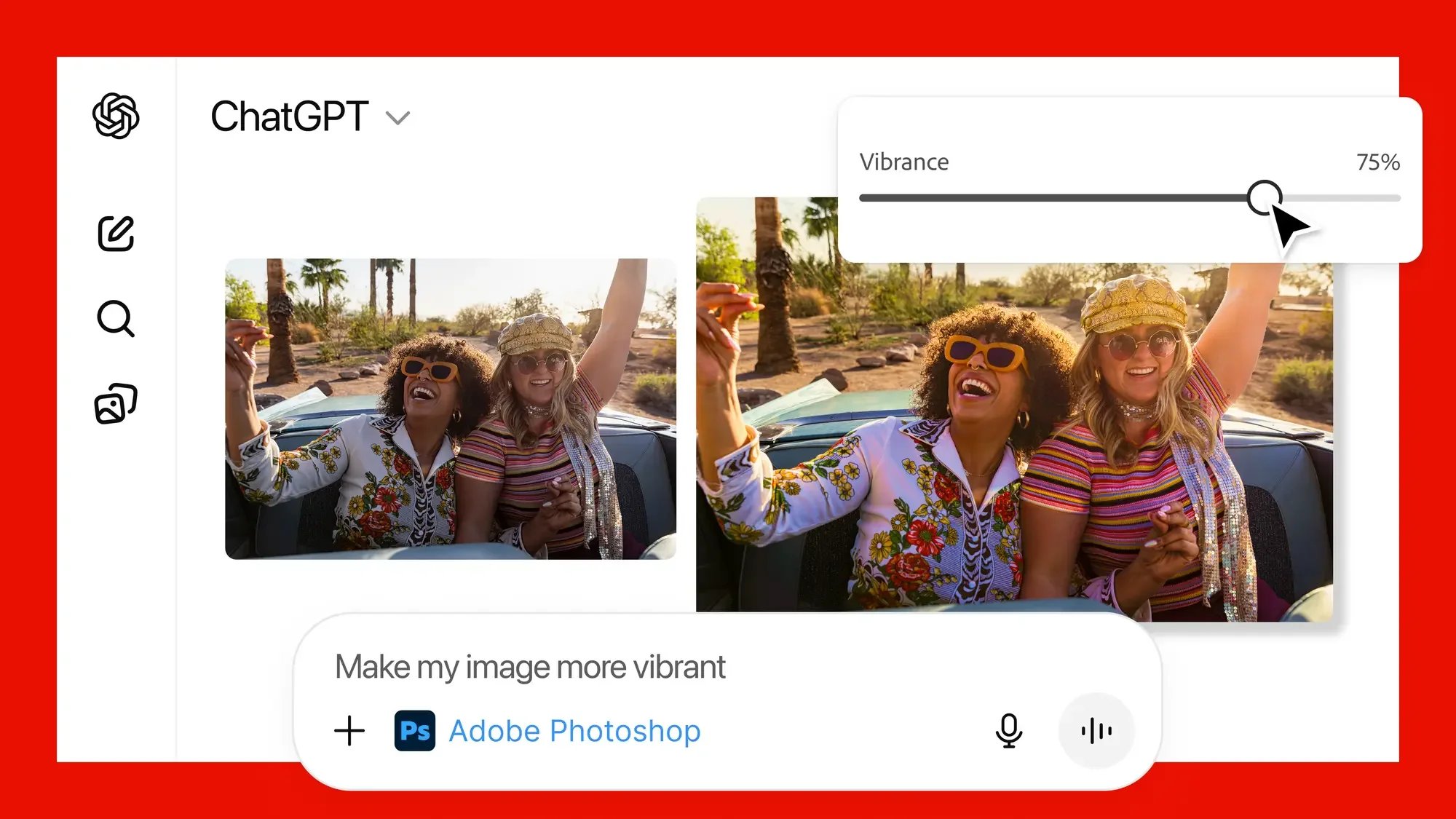
Image courtesy of Adobe
Why only filters, colour, and “safe” edits?
Because Adobe isn’t shipping a feature. They’re managing risk. Exposing destructive or generative actions inside a conversational interface introduces:
copyright ambiguity
provenance concerns
licensing confusion
trust and expectation problems
Preset-style adjustments are:
explainable
reversible
low-risk
easy to support
They’re not impressive. They’re strategic.
The real play: controlling the interface of creativity
This launch isn’t about Photoshop. It’s about where creative intent is expressed. Chat interfaces are quickly becoming the default place where people:
describe what they want
explore ideas
make decisions
If creative intent starts forming in chat, Adobe has two options:
fight it
or embed itself inside it
Photoshop in ChatGPT is Adobe choosing the second option. Not to replace tools — but to remain present at the moment decisions are made.
What this signals about where creative tools are heading
This is the part most people are missing. We’re watching the early separation of:
intent
constraint
execution
Chat becomes the intent layer. Professional tools become execution engines. This aligns with a broader shift toward:
modular creative systems
composable actions
node-based workflows
multiple interfaces sitting on top of the same engine
ChatGPT is just one surface. Photoshop is becoming infrastructure.
Why designers feel underwhelmed… and why that’s good news
If this integration feels basic to you, that’s confirmation — not concern. Because your value as a designer was never just about clicking buttons or memorising menus. Your value lives in judgment, constraint, systems thinking and your taste. And none of that can be safely abstracted into sliders. Yet. As designer and educator Mike Monteiro famously put it: “Design is the intentional solution to a problem.” Intent is the last thing to be automated.
What designers should actually be paying attention to
Instead of asking “When will ChatGPT do full Photoshop?”, better questions are:
Who controls the interface of creativity?
Where does intent get formed?
How do we direct systems instead of operating tools?
What happens when execution becomes cheap?
This is why the future doesn’t look like one tool to rule them all. It looks like connected systems guided by language, taste, and judgment.
Want to learn how to actually connect AI into your creative workflow?
FAQs
Q: Is Photoshop in ChatGPT replacing Photoshop?
A: No. It’s an entry layer for simple edits, not a replacement for professional workflows.
Q: Is this feature free?
A: Yes, basic Photoshop-powered edits inside ChatGPT are free. Full control still lives in paid Adobe products.
Q: Why does it feel so limited?
A: Because it’s intentionally constrained to safe, non-destructive operations.
Q: Should professional designers be worried?
No. If anything, this shift increases the value of taste, direction, and strategic thinking.
Final thought
Photoshop in ChatGPT isn’t underpowered. It’s strategically constrained. Not because Adobe doesn’t know how to build powerful tools, but because they’re preparing for a future where creativity starts with language, not interfaces. The tools will keep changing. Taste still belongs to humans.