
WHY DESIGNERS ARE SLEEPING ON THE CREATOR ECONOMY—AND WHAT AI HAS TO DO WITH IT
Most designers I know would rather stub their toe than make a TikTok. There's a reason. A decade or two of training in studios and agencies builds a very specific definition of "real work" — and that definition usually involves a brief, a client, a critique round, and a printed (or pixel-perfect) deliverable that lives somewhere defensible. The work flows from a known place to a known place. The craft has guardrails.
The creator economy doesn't work like that. And for a generation of trained creatives, that's been quiet permission to look the other way. Which is exactly why this month's Creative Futures Hub session is going to be a productive provocation.
The work is flowing. You're just not in the room.
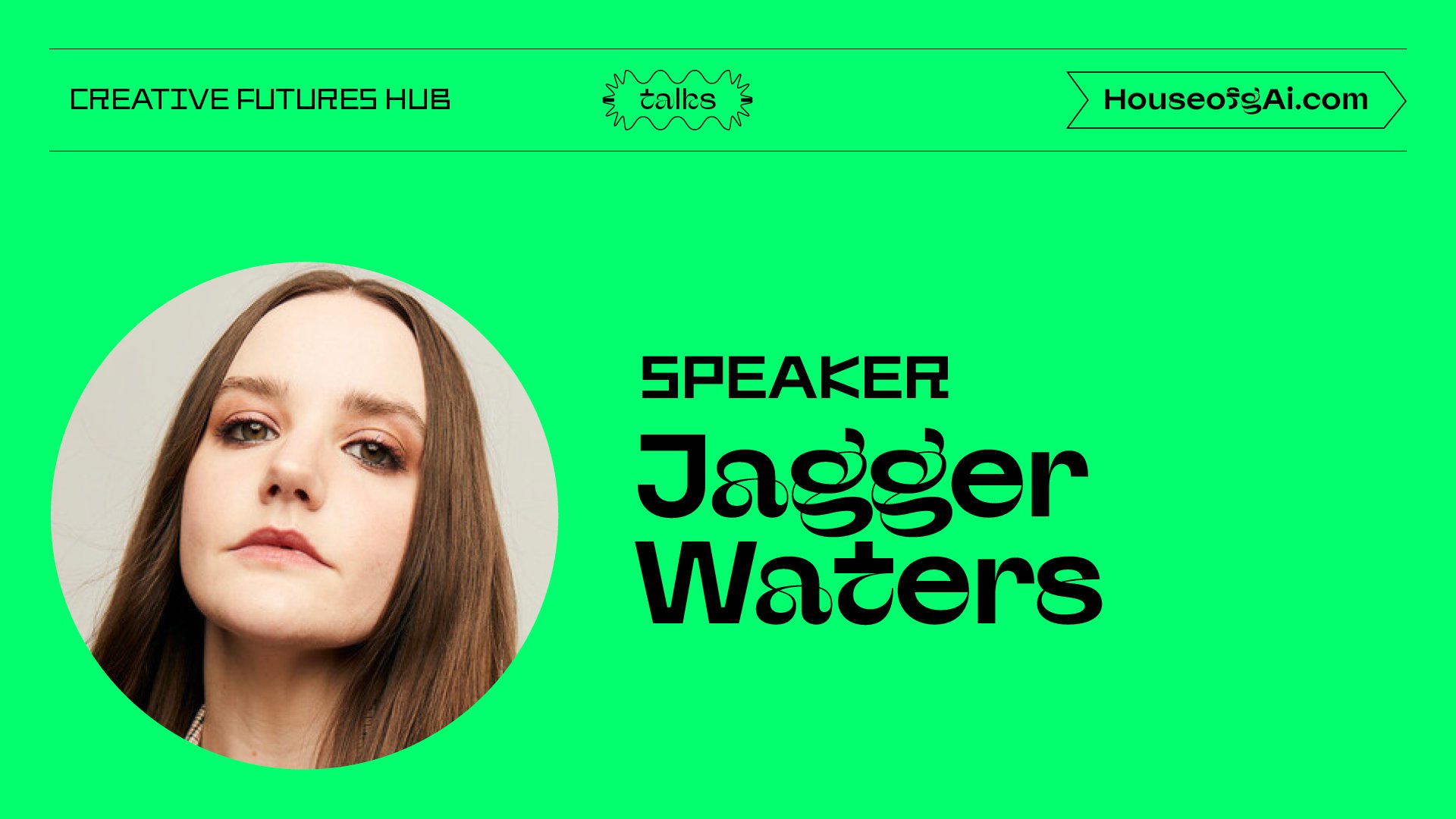
Jagger Waters has spent the last few years sitting at an intersection most designers haven't dared to look at directly: AI, advertising, and the creator economy. She's an LA-based writer, producer, and award-winning AI filmmaker — recognised by SXSW, the Sundance Institute, Adobe, Cannes, and the Producers Guild of America — and she currently runs a digital management company focused on creator education while serving as Director of Programming at Escape.ai.
What that means in practice: she has a clear-eyed view of where the creative work is actually flowing right now. And she's not being gentle about the fact that most trained creatives are pretending it isn't.
Her point isn't that designers should drop everything and start running TikTok funnels. It's sharper than that. The creator economy is where financial flow and creative freedom are most accessible right now, and treating it as somehow beneath the craft is a strategic mistake dressed up as good taste.
We were trained to think of the creator economy as the place where "content" gets made. The thing is, content is what the market is actually paying for. Designers just decided we were too good for it.
In a 2024 Substack piece that should be required reading for any creative trying to think clearly about AI and the industry, Jagger borrows a line from Mad Men — Don Draper to Peggy, in a moment of corporate frustration:
"They can't do what we do, and they hate us for it."
She uses it to frame why creatives keep getting misread by the people writing the cheques. The piece argues that the entire AI-replaces-designers panic is a symptom of the same scarcity logic that's run Hollywood, advertising, and design into the ground. We were trained to see creative work as a zero-sum pie. Someone else's success is your failure. Someone else's tool is your obsolescence.
But here's where the creator economy starts to bend the math. When AI raises the production ceiling for solo creators, the pie stops being a pie. A skilled designer with a developed eye, a clear point of view, and the right AI workflow can produce work that competes with small agency output — solo, on their own terms, on a platform that pays attention.
The question isn't will AI replace designers? The question is whether the designers who could be running their own creative platforms are still waiting for someone to give them permission to.
AI is the production ceiling, not the floor
This is where Jagger's second angle clicks into place — because the creator economy conversation only really lands once you understand what AI actually changes for the work itself.
Her framing, which she pulled apart with us in our prep call: AI is the best proof-of-concept tool creatives have ever had. It lets you demonstrate vision before the funding arrives.
For a designer, that translates exactly. The pitch deck that used to be a mood board and a prayer can now be a brand world, a campaign feel, a fully realised visual argument. Not finished work — but enough of the right visual evidence that the client's imagination doesn't have to do all the heavy lifting. Jagger's currently building a spec ad from scratch — no client, no brief, no budget — specifically to demonstrate this workflow in action. We'll walk through it on the call.
That same shift is what makes the creator economy newly viable for trained creatives. Five years ago, you needed a small production company behind you to make work that competed at scale. Now you need taste, judgment, and a workflow.
AI makes average infinite. Your taste is what's scarce.
The designers winning right now aren't the ones who learned AI first. They're the ones who realised the production barrier was the only thing keeping them out of the bigger game — and stopped pretending it was still there.
The catch (because there's always a catch)
Both of us said it in our prep call: shit in, shit out.
AI doesn't replace your taste. It amplifies whatever you bring. Which means a designer with a developed eye, a strong point of view, and ten years of craft behind them is now genuinely dangerous in a way they couldn't have been before. And a designer who's been coasting on technical execution — who never built the upstream judgment muscle — is going to get exposed.
The creator economy doesn't reward production polish in the way agencies do. It rewards a take. A point of view. The willingness to show up, repeatedly, with something that's actually yours.
This is the part that should be exciting. Designers have been quietly building this exact muscle their entire careers — every brand strategy session, every concept presentation, every "what's this trying to say" moment in critique. The taste is already there. The platform is just open now.
What this means for your practice
Both threads — proof-of-concept workflows for client pitches, and the creator economy as a legitimate professional frontier — point at the same underlying shift. The gap between idea and execution is narrowing, and the creatives who understand that are quietly building different kinds of leverage.
The designer who can mock up a full brand world in a client pitch is a more powerful designer in the room. The designer who treats their practice as a creative platform — with an audience, a voice, and direct distribution — is less dependent on any single client relationship. Neither of these requires abandoning the craft. Both require engaging with tools most designers are still watching from a distance.
Or, as Jagger puts it in her Substack: human talent and experienced storytellers aren't necessary despite the new tools. They're necessary because of them.
If you bring nothing, you get more nothing, faster. But if you bring genuine craft, a developed eye, and a clear point of view — you now have a studio inside your laptop. The question is whether you're going to use it.
JOIN THE CONVERSATION
Jagger Waters joins the Creative Futures Hub for a live fireside chat on Monday 25 May, 12:00pm Pacific / 1:00pm CST / 3:00pm Eastern / 8:00pm UK.
We're digging into both threads: the proof-of-concept workflow that's reshaping how designers pitch, and the creator economy reframe that most trained creatives need to hear. 35 minutes of conversation, 15 minutes of live Q&A.
Bring the questions you've been sitting on.
Join the session inside the Creative Futures Hub →
Already a member? RSVP here
FAQs
What is the creator economy and why should designers care? The creator economy is the ecosystem of independent creators who build audiences and monetise directly through platforms like Instagram, TikTok, YouTube, and Substack. For trained designers, it's increasingly where creative freedom and financial flow are most accessible — and AI tools have raised the production ceiling enough that solo designers can now produce work that competes with small agency output.
How can graphic designers use AI for client pitches? AI lets designers build full proof-of-concept material — brand worlds, campaign moods, motion concepts — before any production budget is committed. Instead of pitching with mood boards and reference decks, designers can show clients a fully realised visual argument, dramatically closing the gap between idea and execution.
Will AI replace graphic designers? No, but it will likely raise the bar for what designers are expected to deliver. AI amplifies the taste and judgment a designer brings to the work. Designers with developed craft and clear points of view become more powerful with AI tools, while those relying on technical execution alone may struggle to differentiate.
Who is Jagger Waters? Jagger Waters is an LA-based writer, producer, and AI creative strategist with over twelve years across film, TV, VR/XR, scripted podcasts, and the creator economy. Her work has been recognised by SXSW, the Sundance Institute, Adobe, Cannes, the Producers Guild of America, Forbes, and the Television Academy. She currently serves as Director of Programming at Escape.ai.
When is the next Creative Futures Hub fireside chat? The next Creative Futures Hub fireside chat with Jagger Waters takes place on Monday 25 May 2026 at 12:00pm Pacific / 1:00pm Central / 2:00pm Eastern / 7:00pm UK, live inside the Creative Futures Hub community on Kajabi.