
CHATGPT WORK JUST MADE AGENTS MAINSTREAM. DELEGATION IS YOUR NEW SKILL
Your chat is a mess right now. Mine too. OpenAI shipped ChatGPT Work, folded Codex into the desktop app, quietly renamed the old app "ChatGPT Classic," and rolled out a new voice mode on top. Then it scattered the buttons so that what you see depends on whether you're on desktop, web or mobile, and whether the rollout gods like you today. The universal first reaction, from designers to developers, has been roughly: what the hell is this?
Fair. The naming is a disaster and the walls between the modes are flimsy. But if you stop at "this is confusing," you miss the thing that actually happened. For a billion people, ChatGPT just stopped being a place you ask questions and became a place you hand over work.
So what actually launched?
Here's the plain version, minus the OpenAI keynote gloss.
ChatGPT now has three doors. Chat is the old thing: ask a question, get an answer. Codex is the full developer setup, now living inside the ChatGPT desktop app instead of on its own. And Work, powered by the new GPT-5.6 model, is the one that matters for you. You give it an outcome, and it plans the approach, pulls context from your connected apps and files, works across your desktop, and comes back with finished spreadsheets, docs, slides and web apps. It can stay on a job for a good while, break it into steps, and ask permission before doing anything with consequences. You can interrupt it, take over, or stop it whenever you like.
There's also a new voice mode, GPT-Live-1, that speaks and listens at the same time so you can talk over it like a person. Nice. But voice is the shiny bit. Work is the shift.
Same house, three doors. The doors are just badly signposted.
I went looking for my custom GPTs and hit a wall
Confession: I hit this live this week, and it's worth telling you exactly what happened, because the frustration out there right now is real and I experienced it first hand.
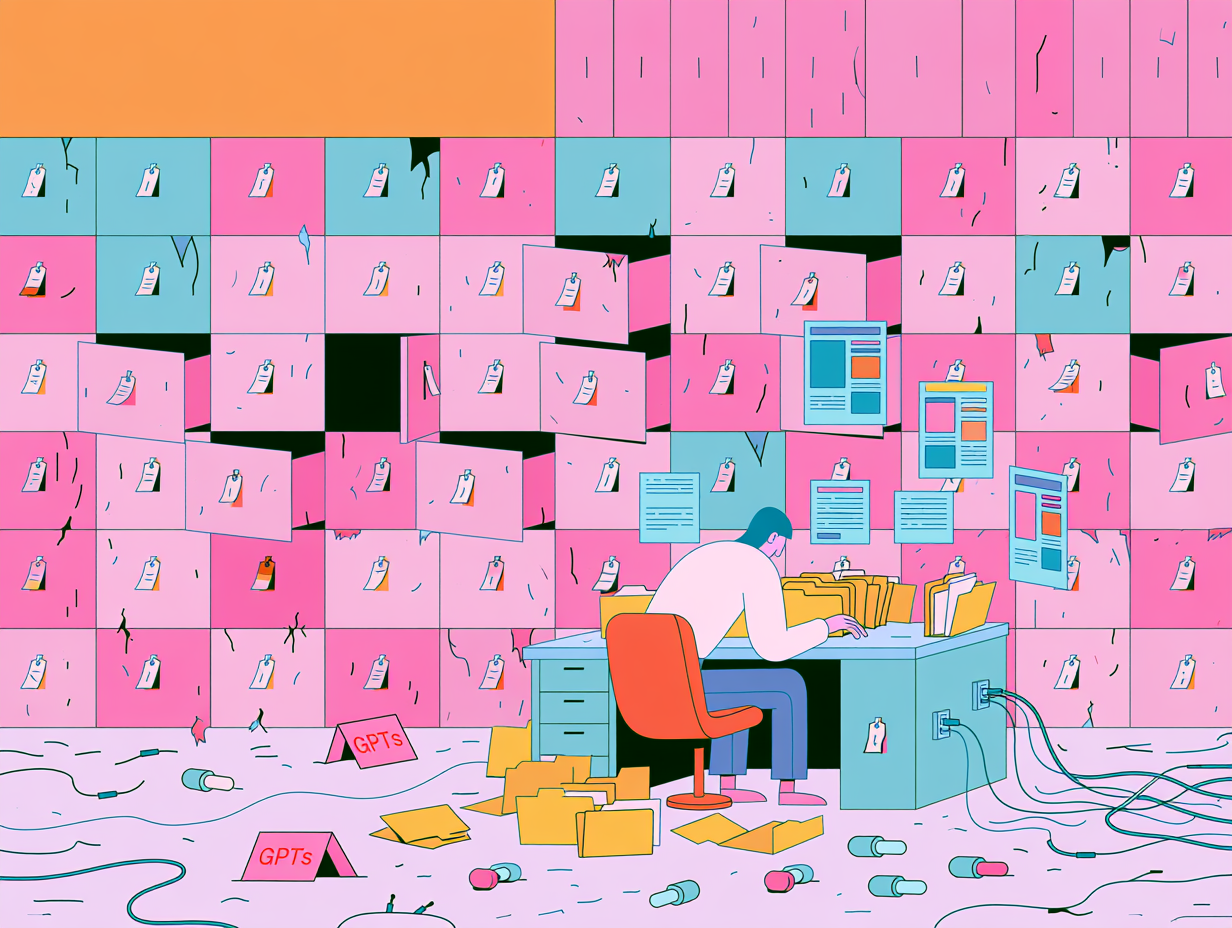
I opened the new Mac app to grab one of our course custom GPTs. The top dropdown gave me two options: Work and Codex. No Chat. My recent conversations had collapsed to a handful, with the rest buried behind a "See all." And my custom GPTs, the ones we build and teach with every week, weren't in the new app at all. Not hidden, not renamed, just not surfaced. I had to open the browser and ChatGPT Classic to find them sitting exactly where they'd always been.
I'm not special here. The OpenAI community forum has a thread calling the update "a confusing, unnecessary mess," and the tech press has covered users being, to put it kindly, up in arms over broken workflows. When the tools you open every day quietly leave the building, "up in arms" is fair enough.
So yes, the rollout is a shambles. Bank that. Now here's the twist worth staying for.
One toggle, a billion people, an agent
Power users are annoyed, and I get why. If you've been turning Codex or Claude Cowork into a personal assistant for months, "agent mode" behind a toggle feels redundant. You already had this.
But you are not the audience. Here's the newsletter writer Kyle, whose WhatsApp is apparently full of peeved people this week, landing the point better than the launch did:
"There are millions (nay, 1 billion) people who will happily use ChatGPT every day and will never install Codex, Claude Code or a coding agent. They hear 'coding agent' and do one. Give them a toggle marked Work though... they'll get that. And because of that they've just been handed agentic AI."
That's the whole story. Distribution, not capability. Agents that plan and act and deliver have existed for a while now. What changed this week is that the most familiar app on earth put one behind a friendly little switch, and the people who'd never go near a terminal just got a junior that works for twelve minutes while they make coffee.
Ethan Mollick has been calling this shift for a year: the chatbot era is winding down, and agents that go away and finish real work are moving in. His read on where the leverage lands is the part designers should tattoo somewhere visible. The advantage now goes to the person who can define the job and check the output, not the person who can phrase a clever prompt.
Which is a very polite way of saying the ground just moved under your feet. In a good direction, if you know where to stand.
The unit of work changed, so the skill did too
Chat trained all of us to ask, "How do I make this report?" Work lets you say, "Make the report. Here are the meeting notes, the source files, the format I need. Bring me a finished draft."
That's a different job entirely. You've stopped being the person doing the task and become the person directing it. And directing work you're not personally executing has a name that every studio already uses: delegation.
This is where creatives have an unfair advantage, and most of you haven't clocked it yet. You already know how to hand a brief to a junior, an intern, a freelancer or a strapped-for-time colleague and get something usable back. You know the difference between a brief that produces good work and a two-line Slack message that produces three rounds of wrong. The tech industry spent two years reinventing this and calling it "context engineering." Strip the vocabulary off and it's a creative brief. We wrote about exactly that in Stop Prompting, Start Briefing, and ChatGPT Work is the reason it now matters to your whole team and not just the early adopters.
Milton Glaser, the man who gave New York its most-copied logo, put the job of a designer like this: "To design is to communicate clearly by whatever means you can control or master." Work is a new means. Mastering it isn't about learning secret prompt syntax. It's about getting sharper at the thing you already do when you brief a human: saying clearly what you want, for whom, within what limits, and what "done" actually looks like.
Your prompting skills didn't die. They grew up.
Let's kill a myth before it spreads. "Agents mean prompting doesn't matter anymore" is wrong, and lazy.
Prompting was never about magic words. It was communication. The clearer you can describe the result, the context and the boundaries, the less rubbish comes back. That's more true of an agent, not less, because now your instructions get handed to a system that will run with them for twelve minutes instead of firing back one answer you can eyeball and fix. A vague brief no longer costs you one bad paragraph. It costs you a finished, confident, wrong deliverable.
So the briefing skill isn't optional homework. It's the whole game. The six-part agent brief we broke down in the briefing article transfers straight to ChatGPT Work: deliverable, audience, constraints, references, a definition of done that forces the agent to critique its own work, and anti-goals, the list of things you never want to see. Give it those four things Work asks for, spelled out, and you get a draft worth editing. Give it a Post-it, and you get slop at scale.
Taste still doesn't loop
Now the part the hype merchants skip.
An agent runs in a loop. It drafts, checks, revises, drafts again. That loop is brilliant for the grind: the research, the first structured pass, the boring 80% that eats your Tuesday. What the loop cannot do is decide which of three finished directions is the right one to put in front of a client. That's a taste call, and taste doesn't loop. It's the scarce thing, and it stays yours.
You also own what your agent ships. If it asserts a competitor's pricing, you check the source. If it writes strategy off a client call, you confirm nothing was invented. An agent without a definition of done is just AI slop with more steps, and now it's slop that runs for twelve minutes and looks polished enough to fool a tired reviewer. The self-crit isn't a party trick. It's the ethics of the workflow.
The future of design isn't AI versus human. It's the humans who direct AI versus the humans who don't.
Give it one real job
Don't start with a grand plan for an autonomous AI studio. Yeesh. That's how you end up disappointed and back on Chat by Friday.
Pick one job you already do that takes about an hour. A report. Meeting notes that need turning into actions. A pile of reference files that needs analysing. A voice note and a stack of screenshots that need to become a first-draft presentation. Then brief Work like you'd brief a good junior: the outcome you want, the sources it should use, the boundaries it must stay inside, and a clear picture of what done looks like.
Steer it. Let it do the faff while you do the thinking. Then judge the result with the same eye you'd bring to any junior's first draft, because that's exactly what it is.
Update the app. Find the Work toggle. Give it one real job this week. The designers who thrive in this next stretch won't be the ones who learned the tool first. They'll be the ones who already knew how to run a brilliant brief, and finally have somewhere to point it.
Want to build these workflows properly, from a messy client call through to strategy and identity? That's exactly what we do together inside the Creative Futures Hub, and it's the backbone of the AI Branding Masterclass.
FAQ
Why can't I find my custom GPTs in the new ChatGPT app? The redesigned app is built around Work and Codex and doesn't surface custom GPTs. They aren't deleted; they're still tied to your account. Open them in the browser at chatgpt.com or in ChatGPT Classic, where they sit in the sidebar as before. The most reliable route is a direct GPT share link (chatgpt.com/g/...), which opens the GPT no matter which app you're in.
What is ChatGPT Work? ChatGPT Work is OpenAI's agentic mode inside ChatGPT, powered by the GPT-5.6 model and launched in July 2026. Instead of answering a single prompt, it gathers context from your connected apps and files, plans an approach, works across your desktop, and returns finished deliverables like spreadsheets, documents, slides and web apps. It can run for an extended session, asks permission before consequential actions, and can be interrupted or stopped at any point.
How is ChatGPT Work different from regular ChatGPT (Chat)? Chat answers a question in one shot. Work takes an outcome and delivers it: it plans, pulls in your source material, acts across tools, self-checks, and hands back a finished draft. Chat rewards a clever question. Work rewards a clear brief.
What does ChatGPT Work mean for graphic designers and creatives? It moves the core skill from doing the task to directing it. Designers already know how to brief a junior and judge the result, which is the skill an agent needs. The grind (research, first drafts, structured analysis) can be delegated. The taste call (which direction to choose, what to put in front of a client) stays human.
Do prompting skills still matter with agents? Yes, more than ever. Prompting was always communication, not magic words. With an agent that runs for minutes on your instructions, a vague brief produces a polished but wrong deliverable rather than a single fixable answer. Clear briefing is the whole game.
How do I brief ChatGPT Work well? Use the anatomy of a creative brief: deliverable, audience, constraints, references, a definition of done that makes the agent critique its own work, and anti-goals (what you never want to see). Tell it to verify facts it can check and to flag facts it can't, rather than inventing them.