
SOFT SKILLS FOR DESIGNERS IN THE AI ERA
Execution is abundant. Judgment is scarce. For most of modern design culture, the gold star has gone to the designers who can execute. The ones who are fast, reliable, and weirdly calm when the brief changes three times, the budget halves, and someone’s cousin “just has a few thoughts” in the final review.
You know the type. You might be the type. Execution is not a dirty word. Execution is craft. Execution is taste made visible. Execution is how you turn something vague and wobbly into something people can actually use, sell, share, or ship. There’s a reason designers still romanticize the perfectly kerned poster, the crisp grid, the logo that works at 12 pixels and on a billboard. We’re not giving that up.
But AI is changing what gets rewarded, not because it has taste (it doesn’t), but because it makes output plentiful in a way that’s honestly… unsettling.
Execution is abundant. Judgment is scarce. And as the supply of “pretty good” design explodes, the thing that becomes more valuable isn’t your ability to produce more. It’s your ability to decide what matters.
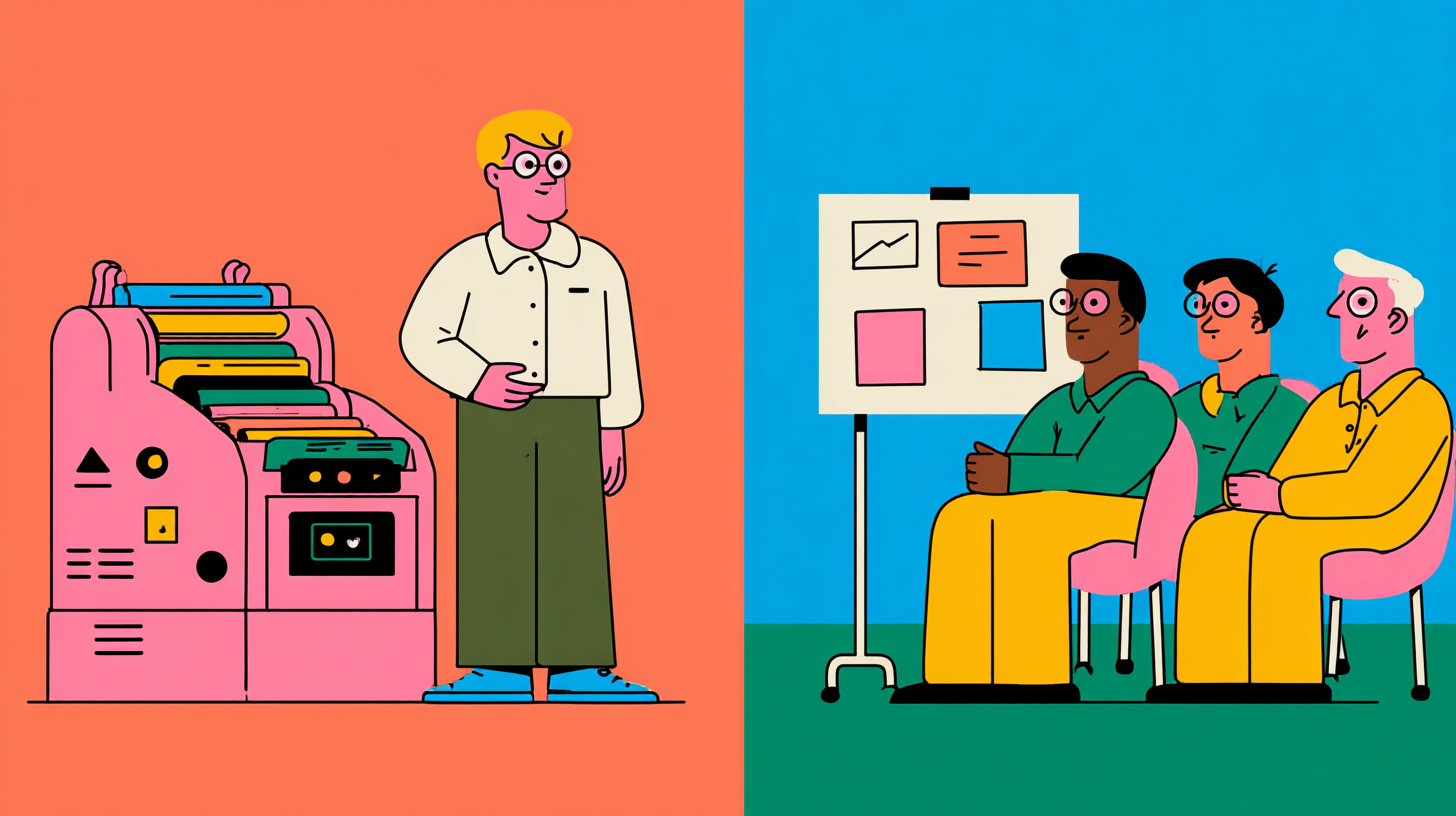
Why “soft skills for designers” suddenly matter more than ever
Let’s say AI gets you fifty variations in five minutes (and yes, the internet loves saying that like it’s a flex). Even if the “five minutes” part is a little influencer-y right now, the direction is obvious: more outputs, faster, with less friction.
So the question stops being, “Can you make options?” Because everyone can make options.
The question becomes:
Can you choose the right direction instead of the most exciting-looking one?
Can you tell what’s strong… versus what’s just shiny?
Can you explain why it works—strategically, emotionally, and contextually—without sounding like you swallowed a brand book?
Can you cut. Shape. Simplify. Protect the idea until it becomes inevitable?
These are the skills that have been sitting under the label soft skills for years: communication, storytelling, taste, discernment, judgment, facilitation, leadership.
They’ve always mattered, but now they’re the difference between being a designer who uses AI and being a designer who gets outpaced by it.
The execution trap (and why it’s not your fault)
A lot of creatives have accidentally been trained into what I call the execution trap: you get really good at making, so people keep rewarding you for making, so your role becomes… making. More decks. More options. More campaigns. More layouts. More versions. More “can we just explore one more direction?”
It’s like being the person at the party who makes the best playlist, and suddenly you’re DJing every party forever. At first it’s flattering. Eventually you’re trapped behind the aux cord.
The execution trap isn’t about lack of talent. It’s about the type of value the system has historically rewarded. Schools reward output. Workplaces reward speed. Clients reward “make it look good.” Agencies reward throughput. Most performance reviews aren’t exactly grading “discernment” like it’s a subject you can study on Khan Academy.
So it makes sense that many designers become purely executional — especially mid-career — because that’s what was asked of them.
AI just made that value proposition wobble.
What design judgment looks like in real life
Judgment isn’t a vibe. It’s a series of decisions you can point to. In practice, “judgment” for a graphic designer looks like:
Brief translation: turning messy inputs into a clear decision to make
Constraint setting: defining what “good” looks like before you generate anything
Taste + discernment: knowing what to keep, what to cut, and what’s off-brand even if it’s “cool”
Narrative: connecting the work to a story a client can repeat in a meeting
Stakeholder navigation: guiding people toward alignment without designing by committee
Decision-making under ambiguity: moving forward without perfect info
If AI is a generator, judgment is the steering wheel. And if you’ve ever watched someone present a concept with no story — just a sequence of deliverables — you already know why this matters. The work might be gorgeous, but without judgment and narrative, it lands like a beautiful song with no chorus. Plenty of sound, not much to hold onto.
Taste is a skill (and it can be trained)
This is the part that tends to either annoy people or relieve them, depending on their mood and caffeine levels:
Taste is a skill.
It’s not something you either have at birth or don’t. It’s trained through reps: references, pattern recognition, critique, standards, and context.
Taste is:
the ability to recognize what’s working and articulate why
the ability to spot when something is generic even if it’s technically well-made
the ability to choose the right idea for this audience, this product, this moment
the courage to edit when more output is available
AI increases the volume of possible choices, which means taste gets tested more often — and that’s good news for designers who are willing to train it. Because when everyone can generate, the advantage shifts to the person who can curate.
The real anxiety designers are feeling
Most designers aren’t terrified that “AI will replace design” in the abstract. The anxiety is more specific than that. It’s the feeling of becoming less essential.
If AI can produce a “pretty good” logo, a “pretty good” layout, a “pretty good” poster, a “pretty good” campaign concept… what is the client actually paying you for?
They’re paying for clarity. They’re paying for confidence. They’re paying for someone who can make a call.
AI can generate options. It does not magically create conviction. It doesn’t walk into the meeting and say, “Here’s the direction, here’s why it’s right, and here’s what we’re not doing.”
That’s your job.
How AI can help designers build soft skills (without replacing your brain)
If you treat AI like a slot machine—prompt, generate, accept—you’ll get more output, but you’ll develop less authorship. You’ll start feeling like the work is happening to you rather than through you.
But if you treat AI like a sparring partner, it becomes genuinely useful for building the soft skills designers need now.
1) Use AI for critique loops
Give it your directions and ask it to pressure-test them. Try prompts like:
“Score these three directions against the brand strategy and audience. What’s strongest and why?”
“What would a skeptical stakeholder push back on for each option?”
“What’s inconsistent, generic, or unclear about this direction?”
You don’t obey it. You use it to sharpen your judgment.
2) Use AI to practice the story
A great idea that you can’t explain is a fragile idea. Try:
“Turn this concept into a simple narrative: problem → insight → decision → payoff.”
“Write a 20-second version for a CEO and a 60-second version for a marketing lead.”
“Give me three ways to explain this without design jargon.”
3) Use AI to rehearse client pushback
A lot of designers don’t lose the room because the work is weak, they lose the room because they get rattled. Try:
“Role-play a skeptical client. Push back hard on this direction.”
“List five objections a stakeholder might raise, and help me respond clearly.”
“Make my explanation calmer, simpler, and more confident.”
This is practice. Reps. Training. Soft skills in the gym.
What to change in your portfolio if you want to stay relevant
If your portfolio is just a gallery of finished assets, AI makes it easier for clients to think, “Okay… but why you?” Your portfolio needs to show judgment, not just output. Add:
what decision you made and why
what you cut and what you refused to do
the constraints you defined (and how they guided the work)
the narrative that sold it internally
how you used AI (if you did) without letting it flatten the idea
In an AI-saturated world, your differentiator won’t be the final JPEG. It’ll be your thinking made visible.
The takeaway
AI makes execution abundant, which means designers who only execute will feel the squeeze first, not because they’re less talented, but because the market stops paying a premium for something it can get everywhere.
Soft skills for designers—taste, storytelling, communication, judgment—aren’t optional extras now. They’re the scarce advantage. And the designers who win won’t be the ones who use AI to make more stuff. They’ll be the ones who use AI to direct better decisions.
Why the AI Branding Masterclass matters
This is why the AI Branding Masterclass exists. It’s not “how to use AI to generate more.” It’s how to use AI inside a designer-led workflow, so your taste stays intact, your thinking gets sharper, and you become the person who can direct, critique, frame, and lead.
If you want to stay relevant as AI gets better, the goal isn’t to compete with AI at execution. The goal is to become valuable where AI is weakest: judgment. Enroll now to build the skills that don’t get commoditized.
Creative soft skill FAQ
Q1. What soft skills do designers need in the AI era?
A. The most important soft skills for designers in the AI era are judgment, storytelling, communication, and taste. As AI makes execution faster and easier, designers create value by choosing the right direction, explaining it clearly, and leading decisions under ambiguity.
Q2. Will AI replace graphic designers?
A. AI is unlikely to replace designers wholesale, but it will replace or reduce demand for purely executional roles. Designers stay relevant by developing soft skills like judgment, narrative, and strategic thinking — and by using AI as a tool they direct rather than a system that directs them.
Q3. How do you develop taste as a designer?
A. Taste is a skill built through reference literacy, critique, and repetition. Designers develop taste by studying strong work, articulating why it works, practicing editing, and learning to connect creative decisions to context and strategy.
Q4. How can AI help designers improve soft skills?
A. AI can help designers practice soft skills by acting as a critique partner, a stakeholder role-play tool, and a narrative rehearsal assistant. Used well, it helps designers sharpen judgment rather than outsource it.