
THE ROBOTS ARE HERE (AGAIN): WHAT 4 GENERATIONS OF DESIGNERS CAN TEACH US ABOUT AI
Live with Marcus Byrne — Creative Futures Hub, June 2026
In a bedroom in Ireland in the late 90s, a 17-year-old kid showed his uncle a Mac. The kid had a list of fonts. Twenty of them. He could change a typeface across an entire layout in less than a second.
His uncle — who'd spent the last twenty years lettering Bob Marley posters by hand with Letraset, who could spend three hours getting a single headline right — looked at the screen. Looked at the kid. And said:
“Feck. The robots are here. It's not creative.”
Then he walked out. That kid was Marcus Byrne. The robots his uncle was running from were called Adobe Illustrator and Macromedia FreeHand. Twenty-five years later, Marcus is on the other side of the same conversation. And he's coming to Creative Futures Hub to talk about it.
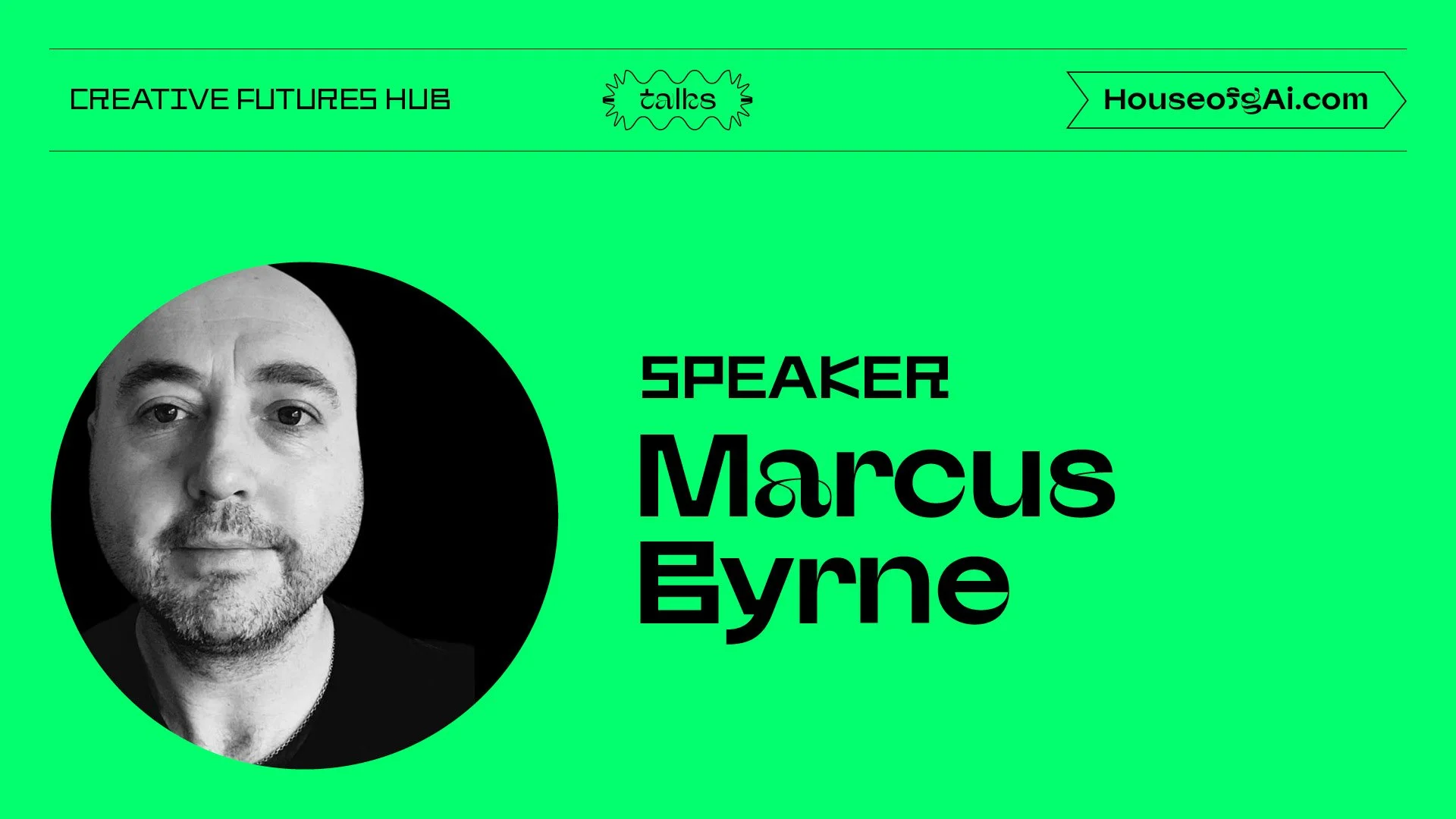
Free talk on the Creative Futures Hub with Marcus Byrne
Four generations of designers, four robot panics
Marcus's family tree is basically a design industry timeline.
His grandad was a typesetter for the Irish newspapers: an industrial-era graphic designer who breathed in molten lead fumes for a living and died at 65 because of it. His uncle Eamon was a 70s poster artist who did everything by hand. Letraset, scalpel, paste-up. His dad was an art director, designer and screen printer.
And Marcus grew up across all of it. Mac at 17. Two decades across Australia's big agencies. Seven years as Head of Art and AI at Tinkerbell. Now a creative partner for Figma Weave, Leonardo AI and Imagine Art. AI:OK board member.
His son Dylan is the fourth generation. He's a kid who draws characters and uses AI to animate them.
Four generations. Four moments where someone older looked at the new tools and said 'this isn't creative.' And four moments where the younger generation kept making things anyway.
That's the talk.
Same story, new robots
Every time the tools change, the panic comes from the same place.
When the camera arrived, painters said it would kill the portrait. It didn't. It made photography a new artform and freed painting up for everything else.
When the car arrived, horseshoe makers said the world would end. It didn't. The car industry ended up creating a hundred times more jobs than the horse one.
When the printing press arrived, scholars said it would kill memory and ruin society. It didn't. It amplified knowledge and made the modern world possible.
When the calculator arrived, maths teachers literally protested.
And when synthesizers arrived, they got banned from recording studios. Then a few minor genres of music came out of them — house, techno, hip-hop, basically every electronic record since 1985.
Marcus's argument isn't 'AI is just another tool, calm down.' He's actually pretty clear that AI is not just another tool. Fire, the wheel, electricity — those were tools. AI is something different, because it can adapt, think, learn, and replace decision-making.
It's an industrial revolution, not an upgrade.
But the response to industrial revolutions has historically been the same: the people who learn to direct them get to make the work that defines the era. The people who refuse get left out of the conversation.
The proof is in the work
This isn't a theoretical talk.
Marcus walks through real campaigns where AI changed the maths.
A Pedigree campaign that took bad photos of shelter dogs and turned them into beautiful, multi-pose portraits. Adoption rates went up. The dogs got homes. AI didn't replace photographers — it gave a charity a budget that didn't exist.
Paula Scher's team at Pentagram generated 1,500 illustrations for a government website where there was no budget for human illustrators. Massive backlash from the design community. But the alternative was no illustrations at all, made by no illustrators. Paula caught heat for being honest about what the brief actually allowed.
His own work: a Guinness rugby idea approved in two days and on a billboard the same week. A 30-second Tesla spec ad — 130 images, 100 video clips, 18 hours, with 99% of the outputs binned. Proof that AI doesn't shortcut the work. It just shifts where the work happens.
The pattern: AI didn't make the campaigns. The ideas made the campaigns. AI made the ideas reachable.
The shift: from execution to direction
Here's the part of Marcus's talk that should be on a fridge magnet:
Your value won't come from execution. It'll come from creative direction, taste, and judgement.
Anyone can generate. Almost nobody can direct.
That's the shift. And the designers who recognise it early are the ones who'll define the next decade — the same way the designers who picked up Macs in the 90s defined the last three.
Rick Rubin puts it bluntly: 'AI doesn't have a point of view.' That's the part that's still ours. The taste. The cultural read. The story underneath the work. The thing that makes a Guinness ad land in two days because someone got the moment.
Two mindsets, same generation
The most quietly devastating moment in Marcus's talk is about two kids.
His niece in Ireland, twelve years old, recently asked her mum: 'What's the point of drawing when AI can do a better job?'
His son Dylan, around the same age: 'I can use AI to bring my characters to life.'
Same tools. Same generation. Two completely opposite mindsets.
One sees a closed door. One sees a production studio in their bedroom.
That's the difference between being threatened by AI and being empowered by it. And it's not about age, or skill, or technical know-how. It's about what you think the tools are for.
Why this talk, why now
This is what Creative Futures Hub is built for.
Not hype-bro takes. Not doom prophecies. Not another LinkedIn carousel telling you to 'embrace the change.'
A working designer with twenty years of receipts, talking to other working designers about how to actually navigate this.
If you've been fluctuating between 'AI is a threat' and 'AI is a superpower' — sometimes in the same hour — this one's for you.
You're not behind. You're not too late. And you're definitely not Uncle Eamon.
Save your seat
The Robots Are Here (Again): Four Generations of Designers on AI A live session with Marcus Byrne, hosted by Anthony Wood.
When: Tuesday 9 June 2026, 3pm Mexico City / 5pm New York / 10pm London (Wednesday 10 June, 7am Brisbane)
The session is free for Creative Futures Hub members, and it's one of dozens that run inside the community every year, alongside student showcases, workshops and a growing library of past talks.
New here? Join the Creative Futures Hub and you'll be in the room for this one, plus everything else inside. Join the Creative Futures Hub
Already a member? RSVP and attend the session inside the community. RSVP for Marcus's session
See you in the room.